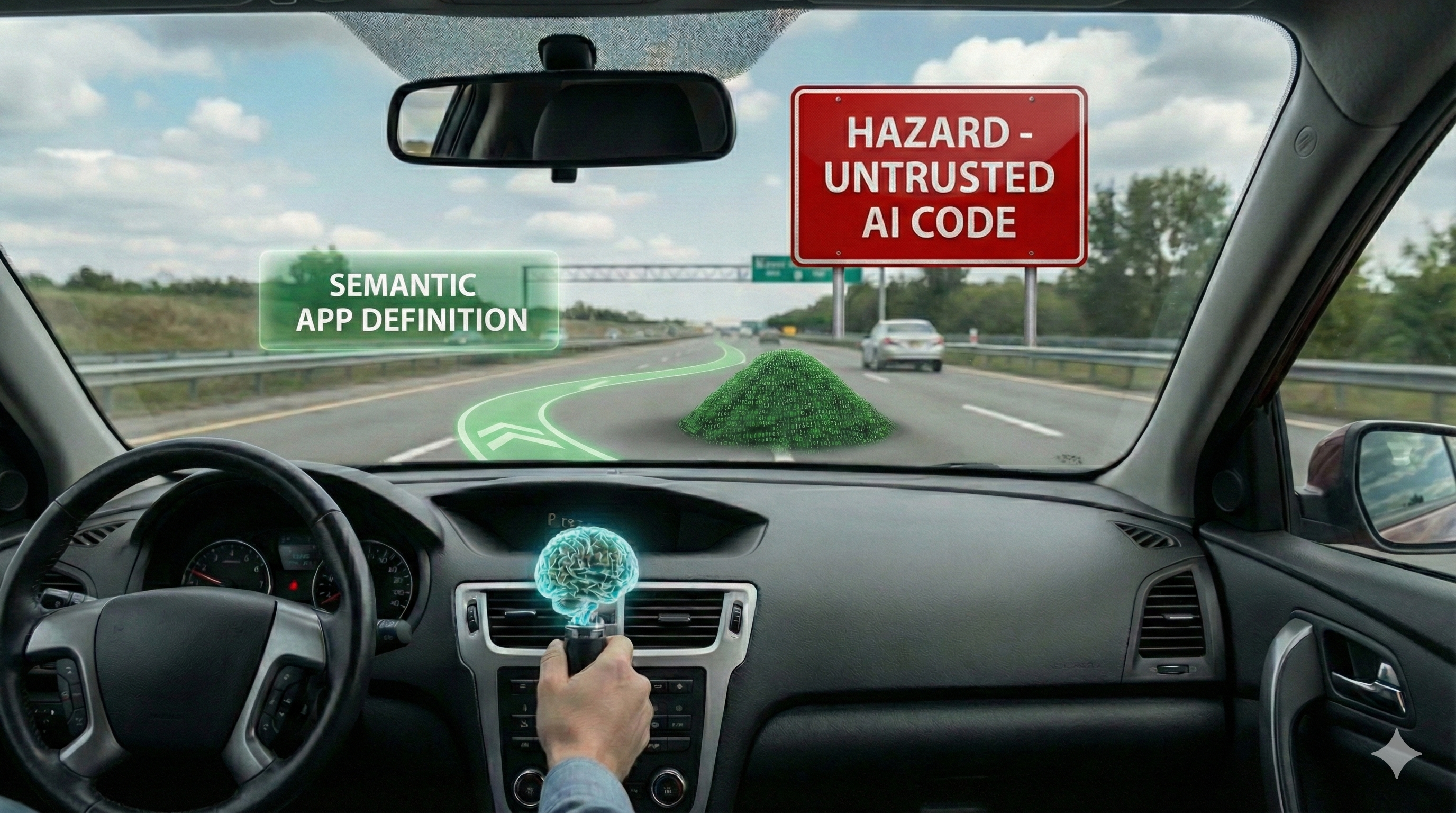
In practice, this approach has hit predictable limits. AI-generated code is often impressive in demos, but fragile in production. It can be hard to audit, difficult to evolve, and expensive to maintain. The deeper problem isn’t model capability — it’s that raw code is a poor interface between human intent and machine execution.
A growing number of platforms — and now major players — are converging on a different idea: AI should operate on semantic models, not free-form code.
Google’s recent introduction of A2UI, an open project for agent-driven interfaces, is a clear signal in this direction. Rather than having AI generate UI code directly, A2UI defines a declarative schema that describes what an interface contains and lets a trusted runtime render it appropriately. The AI produces structure and intent; the system handles execution.
That shift is small in scope — A2UI focuses narrowly on UI to be generated on the fly by AI — but significant in implication. It reflects a broader realization: semantic representations are a more stable boundary for AI than executable code.
The Core Problem with AI Code Generation
The appeal of AI-generated code is obvious: it feels direct, flexible, and expressive. But code is also:
Highly contextual and brittle
Closely coupled to specific frameworks and versions
Difficult to verify for correctness or security
Poor at preserving intent over time
When AI emits code, it collapses what the app is supposed to do and how it’s implemented into a single artifact. Any change — even a small one — risks breaking that implicit contract.
This is why many AI-generated applications struggle to move beyond prototypes. The output works once, but it doesn’t age well.
Semantic App Definitions: A Different Abstraction Boundary
A semantic app definition separates meaning from execution.
Instead of generating code, the system works with a structured, declarative representation of the application:
What screens exist and how users navigate
What data entities exist and how they relate
What actions are allowed and under what conditions
What roles and permissions apply
How UI elements are composed from known patterns
Crucially, this representation is not executable. It’s interpreted by a runtime engine that handles rendering, state management, data access, and platform-specific behavior.
This is the same architectural move A2UI makes for interfaces — but extended across the entire application stack.
Why This Enables True No-Code (and “No-Code Off-Ramps”)
One underappreciated benefit of semantic definitions is how they enable no-code off-ramps.
Because the application is represented as a simplified, declarative structure:
Non-developers can inspect and modify it
Changes can be made visually or via structured editors
AI can suggest updates without introducing opaque logic
The underlying execution engine remains isolated and trusted
In other words, users aren’t editing code — they’re editing the meaning of the app. Execution is handled elsewhere.
This separation is what makes no-code sustainable. Without it, “no-code” tools inevitably accumulate hidden technical debt behind visual abstractions. With it, complexity stays contained.
Google’s A2UI as Industry Validation
Google’s A2UI project is intentionally modest. It doesn’t attempt to define full applications, data models, or workflows. Instead, it provides a declarative format that allows AI agents to describe UI layouts safely and consistently across platforms.
That narrow scope is precisely why it’s revealing.
Google isn’t trying to make AI write better UI code. It’s removing code from the loop entirely and replacing it with a semantic contract between AI and runtime.
This aligns closely with the broader semantic-first architectures emerging in application platforms like Buzzy, which apply the same principle to entire applications — not just interfaces.
A2UI is not a competitor to these systems. It’s a validation of the underlying idea.
Tradeoffs, Clearly Stated
Semantic systems are not without constraints.
They trade some expressive freedom for:
Predictability
Maintainability
Auditability
Platform independence
Free-form code generation can feel more powerful in the short term. Semantic definitions are more disciplined — but they scale better over time.
Given today’s reality — where AI-generated code is often untrusted, difficult to evolve, and expensive to maintain — that tradeoff increasingly favors semantic approaches.
Where This Leaves AI-Driven Development
The trajectory is becoming clearer:
AI will increasingly generate structured intent, not executable artifacts
Trusted engines will interpret that intent across platforms
Application definitions will become durable, versionable assets
Humans and AI will collaborate at the semantic level
Google’s A2UI is an early public signal of this shift. Systems like Buzzy demonstrate what it looks like when the same idea is applied end-to-end.
The future of AI-built software isn’t about writing more code faster. It’s about choosing the right abstraction boundary — and semantic app definitions may be the one that finally holds.
About the Author
Adam Ginsburg is the founder of Buzzy, a platform redefining how applications are built with AI. With deep experience in no-code development, AI-augmented workflows, and product strategy, Adam focuses on bridging the gap between human intent and machine execution. He writes about the evolving landscape of AI in software development, emphasizing semantic models, maintainability, and sustainable innovation. Connect with him to explore the future of AI-native application creation.