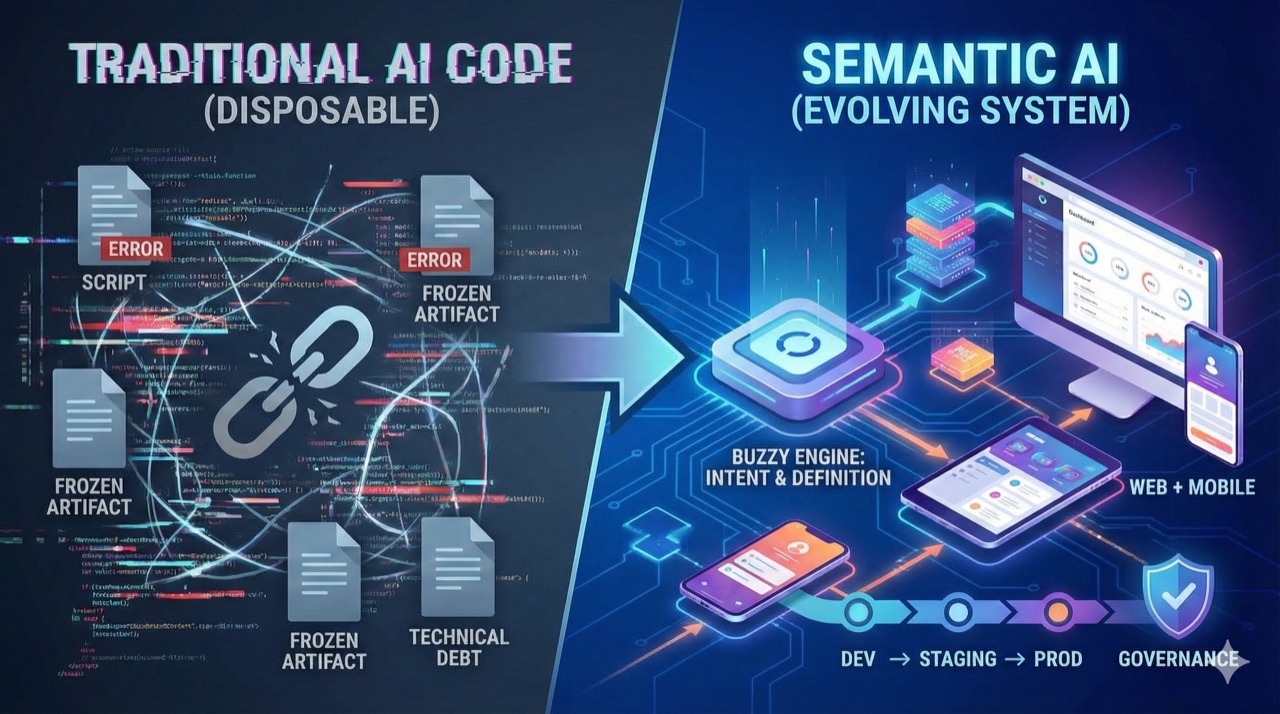
1. The Paradigm Shift: From Disposable AI Code to Durable Systems
The current "AI gold rush" has commoditized software generation, making it possible to manifest applications in seconds. However, for a Senior SaaS Strategist, speed is a deceptive metric if it sacrifices architectural integrity. While raw AI code generation offers immediate gratification, it introduces an unquantifiable maintenance tail that erodes the ROI of rapid development. To ensure software remains a strategic asset rather than a fleeting experiment, organizations must shift from "point-in-time" artifacts to platforms that prioritize long-term architectural stability via immutable definitions rather than mutable codebases.
The Strategic Risks of AI-Generated Code Standard AI app builders follow a "prompt-to-code" workflow that results in significant structural liabilities:
-
Inconsistency: Every generated app is a unique, often siloed codebase. Strategist’s Take: This destroys cross-team standards and prevents economies of scale.
-
Maintenance Debt: You inherit thousands of lines of code that must be manually audited and debugged. Strategist’s Take: You aren't building an app; you're adopting a legacy system on day one.
-
Security Gaps: Vulnerabilities in unique codebases are difficult to patch across an entire portfolio. Strategist’s Take: Security becomes a game of "whack-a-mole" rather than a platform-level guarantee.
-
Governance Hurdles: Without a centralized runtime, enforcing corporate compliance is a manual nightmare. Strategist’s Take: This is the primary driver of high-risk "Shadow IT."
-
Platform Drift: Generated code remains "frozen" at the time of creation. Strategist’s Take: As the tech stack moves forward, your app stays behind, necessitating a full rewrite every 18 months.
The "So What?" Layer: Business Impact In the AI era, technical debt accumulates at a terminal velocity. When an application is a static artifact of a specific prompt, it becomes a liability the moment the underlying environment shifts. These "disposable" codebases are excellent for prototypes, but they lack the robustness required for production-grade systems. To solve these structural issues, a fundamental change in how applications are defined and executed is required.
2. The Buzzy Difference: Semantic Application Definitions
The core strategic value of Buzzy lies in its "Separation of Concerns." By decoupling the application logic (the semantic definition) from the runtime engine (the execution), Buzzy ensures that the business intent remains clear and maintainable, regardless of how the underlying technology evolves.
AI Code Tools vs. Buzzy Architecture
Feature
AI Code Tools
Buzzy Architecture
Output Tyoe
Raw source code
Semantic App Definitions
Maintenance
User must maintain messy output
Buzzy Engine maintains the runtime
Architecture
Inconsistent/Uniqe per app
Shared, consistent and versioned
Evolution Path
Manual refactoring/rebuilding
Centralized, platform-wide updates
The Buzzy Engine Advantage By running applications on a controlled, evolving engine, Buzzy provides three primary architectural benefits:
-
Centralized Upgrades: Engine improvements—such as performance optimizations—automatically benefit all apps on the platform.
-
Instant Security Propagation: Security patches are applied at the engine level, protecting the entire ecosystem simultaneously without developer intervention.
-
Universal Capability Updates: When new features (like AI integrations) are added to the engine, they become available to all existing applications instantly.
The "So What?" Layer: Managing "Software Properly" through semantic definitions allows a business to focus on outcomes and business logic rather than the low-value activity of debugging messy AI-generated source code. This architectural efficiency doesn't just simplify maintenance; it provides the structural backbone necessary to support a truly unified multi-device ecosystem.
3. Unified Ecosystem: Web and Mobile Under One Roof
Multi-platform presence is no longer optional for the modern enterprise, yet the traditional friction of maintaining separate codebases for Web, iOS, and Android creates "platform drift" and fragmented user experiences.
One Definition, Multiple Deployments Buzzy enables a single system of record to serve different user roles across various devices. Utilizing the "hospital" analogy:
-
Doctors and Nurses utilize high-performance native mobile apps for on-the-go patient rounds.
-
Administrative Staff manage scheduling via browser-based dashboards.
-
Shared Data flows seamlessly between both, ensuring that everyone is working from the same real-time system of record.
The "So What?" Layer: With Buzzy, you eliminate the "integration nightmare" of connecting disparate platforms. By using a single definition for the entire ecosystem, Buzzy automates App Store publishing and removes the risk of data silos. This structural unity allows organizations to scale their digital presence without exponentially increasing their maintenance overhead. This operational reach, however, requires the rigorous controls of a professional environment.
4. Enterprise-Ready Governance and Deployment
For established organizations, speed without governance is an unacceptable risk. Buzzy bridges the gap between rapid prototyping and production-grade software by embedding professional SDLC (Software Development Life Cycle) workflows into the platform.
The Software Configuration Lifecycle Buzzy provides structural support for a disciplined Development → Staging → Production workflow. This controlled release cycle is critical for compliance and reliability, ensuring that mission-critical updates are vetted before reaching end-users.
Deployment Flexibility To support varying organizational security and data sovereignty needs, Buzzy offers three hosting tiers:
-
Buzzy Cloud: Managed, high-availability hosting.
-
Private Cloud: Isolated environments for enterprise-specific needs.
-
On-Premise: High-security environments where data must remain within internal networks.
The "So What?" Layer: Buzzy turns "Shadow IT" into "Sanctioned Innovation." Because the runtime is separated from the AI prompts, compliance is structurally achievable and auditable, unlike the unpredictable nature of raw AI-generated code. Being "Enterprise-Ready" also means being "Future-Ready," particularly as AI standards evolve.
5. Future-Proofing Through the Buzzy Engine
The Buzzy philosophy centers on "Vibe Coding"—the shift from writing syntax to directing intent—enabled by "System Thinking." This approach views software as a holistic, living system designed to evolve rather than a point-in-time artifact.
Standardized AI Integration (MCP) Buzzy utilizes the Model Context Protocol (MCP) to ensure AI integrations are standardized across all apps. For example, when Buzzy added MCP capabilities to its engine, the update took only one week to implement. Every Buzzy application—regardless of when it was built—gained access to these new AI widgets instantly. Every app becomes AI-native by default.
Evolution vs. Refactoring
-
Code-Gen Tools: Trap you in a "Rebuild/Refactor" cycle where major updates require manual code manipulation or total rewrites.
-
Buzzy Platform: Enables "Instant Evolution." When the Buzzy Engine improves performance, fixes bugs, or adds security layers, every application benefits instantly without a single line of manual refactoring.
The "So What?" Layer: This represents a strategic competitive advantage: your application gets faster, more secure, and more capable over time. While competitors are burning capital to refactor technical debt, Buzzy users are scaling their business logic.
6. Strategic Alignment: Who is Buzzy For?
While accessible to any creator, Buzzy provides specific ROI-focused advantages to three high-stakes professional segments:
-
Founders: Launch real products, not just demos. Build for speed without the "maintenance tail" of technical debt. As Max Mirho (No-code guru) notes: "You're just talking ideas to an AI and it builds what you want—and that's super, super powerful!"
-
Agencies & Consultants: Offer clients long-term evolution rather than one-off builds. Buzzy allows for repeatable, maintainable solutions that don't become obsolete the moment they are handed over.
-
Enterprise Innovation Teams: Scale operations without compliance risk. Buzzy provides the speed of AI with the governance and architectural stability of an enterprise platform. Elizabeth Alli (Founder, DesignerUp) observes: "This is one of the coolest and most powerful AI tools I've seen."
The "So What?" Layer: Buzzy’s "Build Once, Evolve Forever" philosophy is the only logical choice for high-stakes projects where longevity and Total Cost of Ownership (TCO) are as critical as the initial launch.
7. Conclusion: Turn Vision Into Infrastructure
Buzzy was built by designers and developers who believe software should be easier — not just to launch, but to live with.
It is not merely an app builder.
It is the structural foundation for professional-grade software in the AI era — where durability replaces disposability and evolution replaces rewrites.
The difference is architectural.
And architecture is something you feel the moment you build.
Start Building — The Right Way
Reading about architecture is one thing.
Experiencing it is another.
The fastest way to understand Buzzy is to build something real — not a demo, not a toy project, but an idea you actually care about.
Here’s how to begin today:
• Vibe Code It — Add Buzzy to ChatGPT or Claude via MCP and simply describe your idea. Talk your app into existence.
• Define your data. Shape your workflows. Refine your UX.
• Watch it become a structured, deployable system — not just generated code.
Within minutes, you’ll see the difference:
You’re not managing source files. You’re designing a system. And that system is built to evolve.

Why Buzzy?
Building Software That Evolves, Not Just Apps That Launch