
AI agents have spent the last few years living in the gap between impressive demo and dependable business system. This week, that gap started to look much smaller.
OpenAI and Anthropic both moved deeper into enterprise AI services. Anthropic pushed prebuilt agents into financial services. Collibra launched a governance control plane aimed directly at agentic AI. Google continued to make answer-first search feel less like an experiment and more like the default interface for information. Different headlines, same direction: AI is moving from a tool people consult to infrastructure that participates in work.
That shift matters because infrastructure has a different standard. A chatbot can be useful when it drafts a paragraph. An agent becomes consequential when it reads a customer record, changes a status, starts an approval, prepares a financial model or routes work between systems. At that point the conversation is no longer about novelty. It is about ownership, permissions, workflow design, governance and measurable value.
The week AI agents stopped sounding optional
The strongest signal this week was not one product launch. It was the clustering. TechCrunch reported that Anthropic and OpenAI are both backing new enterprise AI services ventures aimed at helping companies deploy AI inside real operations. Business Insider reported that Anthropic launched finance-focused agents for Wall Street work such as market research, financial modeling and pitch preparation. Collibra launched AI Command Center with language that would have sounded niche a year ago but now feels mainstream: agent registries, lifecycle oversight, trust signals and continuous control.
This is what a market looks like when it starts to move from software adoption to operating-model change. The AI labs are not only selling model access. They are building channels to redesign business workflows around AI. Governance vendors are not only documenting policies. They are positioning around live control of agents that take action. Industry-specific tools are not only answering questions. They are targeting the repetitive work inside banking, insurance, operations and support.
The implication is simple: companies that treat agents as another standalone productivity tool will miss the bigger change. The prize is not a better prompt. The prize is a better workflow.
The adoption numbers point in the same direction
This is not just a vendor narrative. Microsoft’s 2025 Work Trend Index found that 82% of leaders saw that year as pivotal for rethinking strategy and operations, and 81% expected agents to be moderately or extensively integrated into their company’s AI strategy within 12 to 18 months. McKinsey’s 2025 global AI survey found that 88% of respondents reported regular AI use in at least one business function, while 62% said their organizations were at least experimenting with AI agents. The more sobering part of McKinsey’s data is that nearly two-thirds of organizations had not yet begun scaling AI across the enterprise.
That combination is important. AI is everywhere, but scaled AI is still scarce. Agents are being explored quickly, but broad operational maturity is lagging. In other words, most organizations are entering the agent era with enthusiasm but without a complete delivery model.
Deloitte’s enterprise generative AI research tells a similar story. More than two-thirds of respondents said that 30% or fewer of their generative AI experiments would be fully scaled in the next three to six months, while 26% were already exploring autonomous agent development to a large extent. That is the tension every CIO, COO and product leader now has to manage: the technology is moving into execution, but the organization is still learning how to scale safely.
Chatbots answer. Agents operate.
The simplest way to understand the shift is this: a chatbot answers; an agent operates. A chatbot can summarize a support thread. An agent can classify the ticket, check the customer tier, draft a response, update the CRM, escalate the case and prepare the manager’s daily queue. A chatbot can explain a policy. An agent can guide an employee through the policy, collect the required information and create the right internal request.
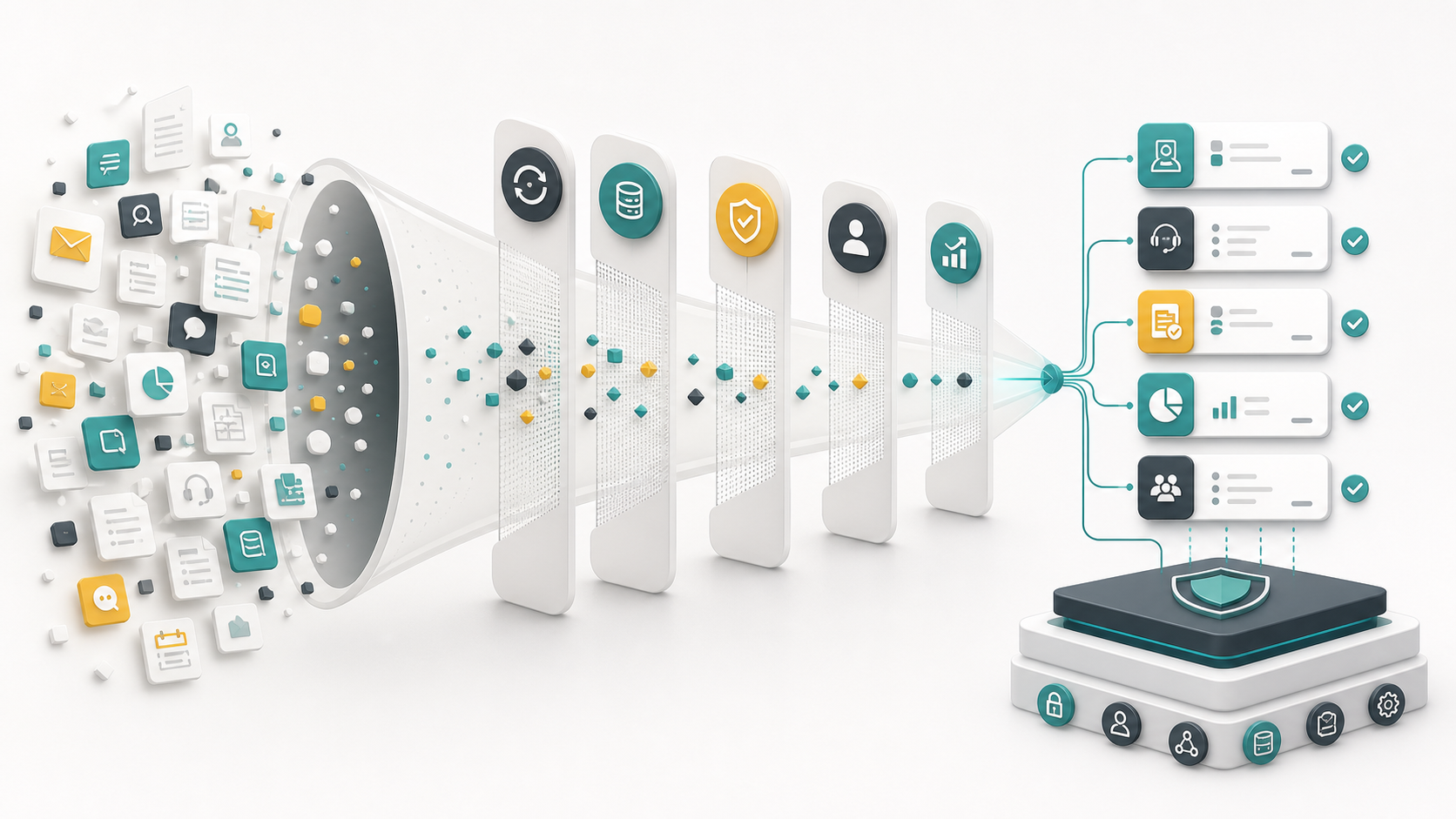
That does not mean agents should be given unlimited freedom. It means they need a clearer operating surface than a text box. They need structured data, defined actions, permission boundaries and escalation paths. They need an application layer.
This is the part many AI strategies underplay. The model is only one component. The workflow around the model decides whether the result is useful, safe and maintainable.
What companies should build first
The best first agent projects are usually not the flashiest. They are the workflows that are frequent enough to matter, structured enough to govern and bounded enough to review. A strong candidate has five traits:
Repeatability: the workflow happens often and follows a recognizable pattern.
Structured data: the agent can work with records, fields, statuses and rules rather than vague documents alone.
Manageable risk: errors can be reviewed, reversed or escalated before they become costly.
Clear ownership: a business owner owns the outcome and a technical owner owns the operating model.
Measurable value: the team can track cycle time, cost, throughput, accuracy, satisfaction or revenue impact.
That points to practical first builds: internal request apps, approval workflows, lead intake, onboarding systems, customer support triage, reporting assistants, field operations tools and status dashboards. These are not science-fiction use cases. They are the connective tissue of most businesses.
The companies that get value fastest will resist the temptation to build one giant agent that does everything. They will build a portfolio of small, governed, useful AI-enabled workflows and improve them over time.
The hidden risk is agent sprawl
Every enterprise software wave creates a sprawl problem. SaaS created app sprawl. Low-code created workflow sprawl. Generative AI is now creating agent sprawl: many small AI systems, each useful in isolation, but collectively difficult to inventory, secure, audit and maintain.
Agent sprawl is more serious than ordinary tool sprawl because agents can act. A poorly governed reporting tool may create confusion. A poorly governed agent can update the wrong record, expose the wrong data or trigger the wrong process. As Collibra’s launch language put it this week, enterprises now need real-time oversight and continuous control because agentic systems do not just suggest answers; they take actions.
The answer is not to slow down every team. The answer is to give teams a common way to build. Shared identity, structured data models, deployment discipline, change control, audit trails and clear ownership should not be reinvented for every agentic workflow.
Search is becoming answer-first too
The same infrastructure shift is happening in discovery. Google’s AI Overviews have already reached enormous scale: TechCrunch reported, based on Alphabet’s Q2 2025 update, that AI Overviews had 2 billion monthly users, up from 1.5 billion earlier that year. Pew Research Center found that users encountering an AI summary clicked a traditional search result in 8% of visits, compared with 15% when no AI summary appeared. Pew also found that only 1% of visits with an AI summary led to a click on a cited source inside the summary.
That should change how companies write. Content now has to work in two places at once: on the page, where a human can read and trust it; and inside answer engines, where clear definitions, structured comparisons and source-backed claims are more likely to be understood.
For B2B companies, this makes answer-engine optimization practical rather than abstract. Publish the pages that answer the questions buyers are asking. Define the category. Explain the tradeoffs. Show the workflow. Cite the evidence. Be clear enough that a human buyer and an AI answer engine can both understand the point.
Why Buzzy fits the agent era
Buzzy is built around a simple but important idea: the durable asset should be the application definition, not just a generated pile of code. Screens, data, workflows, roles, permissions and integrations should be captured in a structured form that can run on a governed platform.
That is highly relevant to agents. If an AI assistant or agent is going to interact with a business system, the system needs structure. It needs to know what a customer is, what a request is, what a status means, who can see what, which actions are allowed and what should happen next. The better the app model, the safer and more useful the agent becomes.
This is also why prompt-to-code alone is not enough for many business workflows. A generated codebase may be fast to create, but every new codebase becomes another surface to secure, maintain and audit. A governed application platform can give teams speed without turning every workflow into its own long-term maintenance project.
The practical mandate
The agent era will reward companies that can make AI operational without making the business chaotic. That means choosing the right first workflows, building them as real applications, setting boundaries early, measuring outcomes and treating governance as part of delivery rather than a checkpoint at the end.
The mistake is to ask, "Where can we add an agent?" The better question is, "Which workflow deserves a better operating model?" If the answer is clear, repetitive, measurable and valuable, then an AI-enabled app may be exactly the right next build.
Want to discuss what that could look like in practice? Book a meeting with Buzzy to discuss further, or visit www.buzzy.buzz to explore the platform.