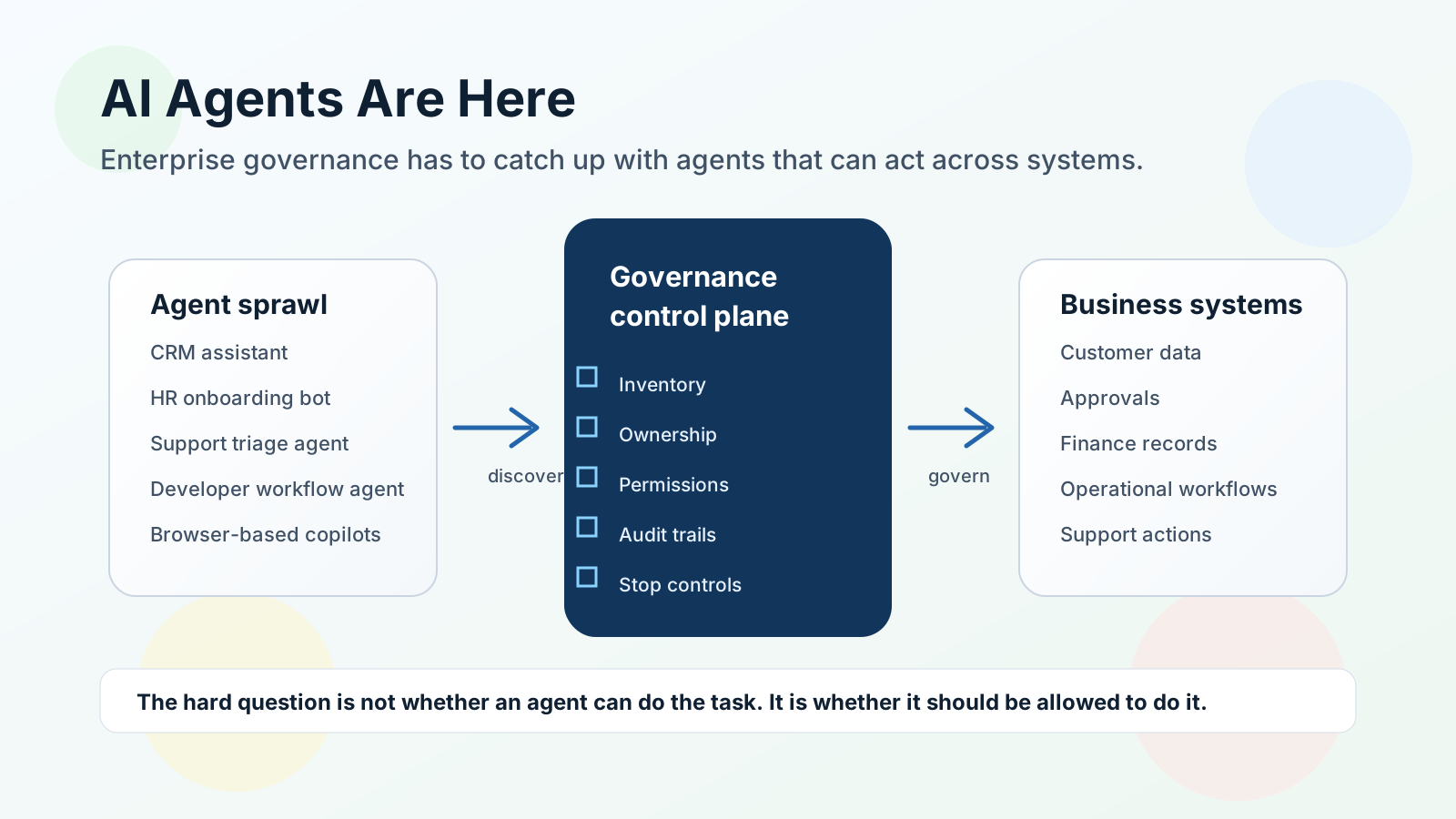
AI agents are becoming part of enterprise work before many enterprises have worked out how to govern them.
That is the uncomfortable shift behind the latest wave of announcements from Microsoft, Google, ServiceNow, Cisco and others. The market is moving beyond chatbots that answer questions and into agents that can reach business systems, use tools, read records, update statuses, trigger workflows and act on behalf of users.
That makes the next enterprise AI challenge less about choosing the smartest model and more about control. Who owns the agent? What systems can it access? What action is it allowed to take? What happens when it gets the right identity but the wrong permission? How does the business audit, pause or roll back what happened?
The practical question is no longer, "Can the agent do this task?" It is, "Should this agent be allowed to do this task, in this context, with this data, for this user, right now?"
The week agent governance moved into the mainstream
Microsoft and Google have both been pushing agent governance into normal enterprise IT administration. Computerworld reported that Microsoft Agent 365 became generally available for commercial customers on May 1, 2026, and is intended to help organizations discover, govern and secure AI agents across Microsoft, third-party SaaS, cloud and local environments. Google has also introduced an AI control center for Workspace focused on administrative visibility, security settings, data protection and privacy safeguards.
ServiceNow is moving in a similar direction from the workflow platform side. Its expanded AI Control Tower is positioned as a way to discover, observe, govern, secure and measure AI systems, agents and workflows across the enterprise. ServiceNow also describes real-time stop controls for agents that go off script or operate beyond their permissions.
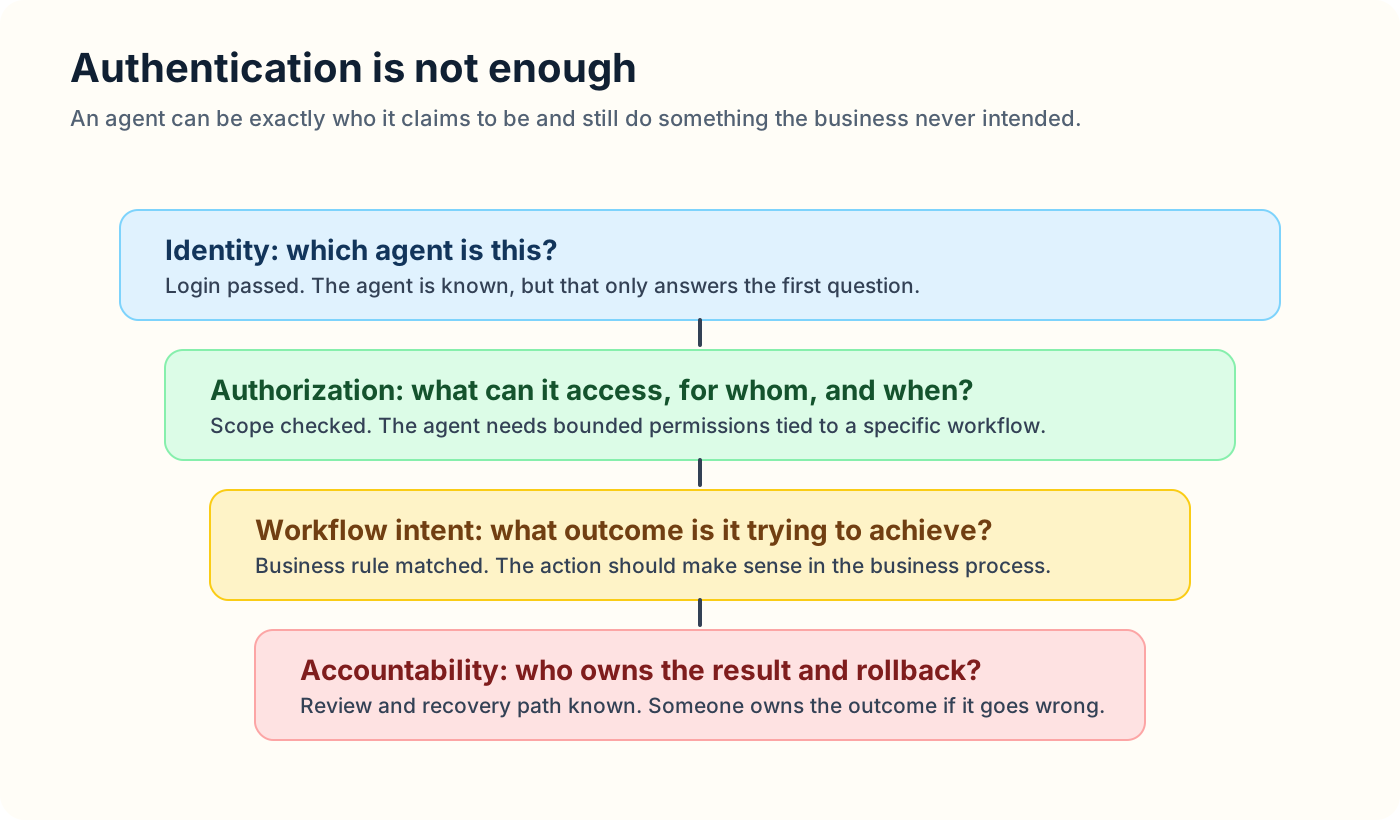
Cisco's latest AI security work points at the same problem from the security side. Cisco's State of AI Security 2026 report says 83% of surveyed organizations planned to deploy agentic AI capabilities, but only 29% felt truly ready to use them securely. VentureBeat's RSAC reporting framed the issue sharply: authentication can pass while authorization still fails.
That is the core governance gap. An agent can be exactly who it claims to be and still access data it should not touch, take an action nobody approved, or chain together steps that produce a business outcome nobody intended.
Why old controls are not enough
Most enterprise identity and access systems were designed around human users. A person logs in, gets assigned a role, accesses an application and performs an action. That model still matters, but agents stretch it.
An agent can operate across multiple tools. It can inherit permissions from a user, a service account, a plugin, an API connection or another agent. It can act quickly and repeatedly. It can read context from one system and apply it in another. It can appear inside a productivity suite, a SaaS platform, a browser extension, a developer tool or a custom internal workflow.
This creates two governance problems at the same time.
The first is visibility. Many organizations will not have a complete inventory of which agents exist, who created them, what they can access, which business process they support or whether they are still needed. This is agent sprawl, and it will feel familiar to anyone who has lived through SaaS sprawl, spreadsheet sprawl or low-code workflow sprawl.
The second is intent. Even when the business can identify an agent, it may not be able to explain why the agent chose a particular action. Logs can show what happened, but not always whether the action matched the business rule, the user's intent or the risk appetite of the organization.
Authentication passing can make the risk harder to see
Security teams are used to treating failed authentication as a clear warning sign. The agentic AI problem is more subtle. The login can be valid. The agent can be known. The credential can be legitimate. The failure can still happen one layer deeper.
Authorization is where many agent risks become operational. A finance agent may need access to expense reports, but not all finance data. A support agent may need to summarize a customer history, but not issue refunds without review. An HR onboarding agent may need to create a checklist, but not change payroll records. A developer agent may need to open a pull request, but not deploy to production without approval.
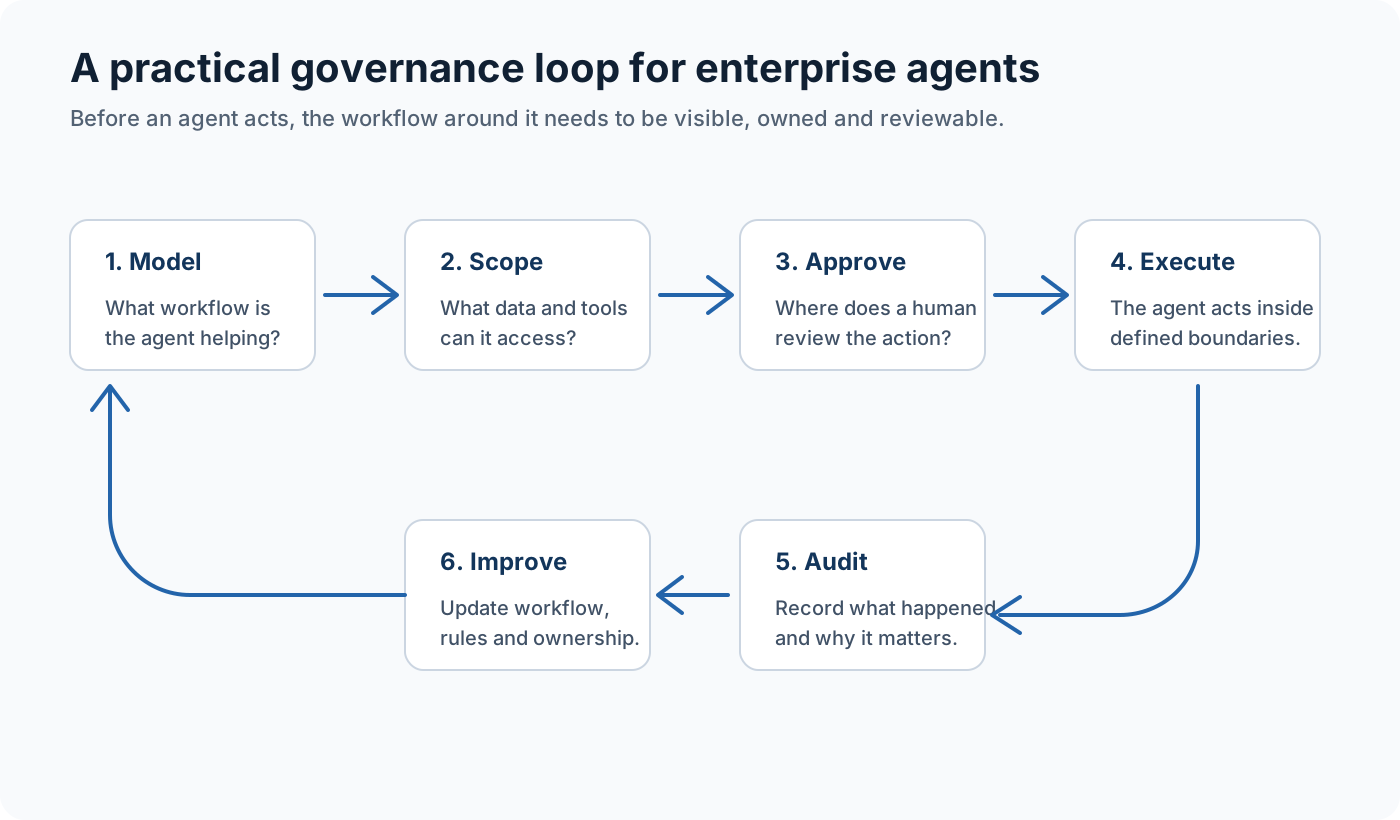
Those are not abstract policy questions. They are workflow design questions. They require the business to define what the agent is meant to do, what data it needs, which actions need human review, what should be logged and who owns the result.
That is why agent governance cannot be solved only by buying a control panel. Tools matter, but the business process underneath the tool has to be explicit.
What good agent governance needs
A useful agent governance model starts with inventory. The organization needs to know which agents exist, where they run, what systems they connect to and who owns them.
It then needs ownership. Every agent should have a business owner responsible for the outcome and a technical owner responsible for the operating model. Without ownership, incidents turn into archaeology: teams have to work backwards through logs, integrations and assumptions to find out why something happened.
Permissions need to be scoped to the actual workflow, not cloned from a human user profile. Agents should get the narrowest access that lets them perform the job. That means thinking in terms of records, fields, tools, actions, time windows and approval thresholds, not just broad application roles.
Approval points need to be designed deliberately. Some agent actions can be fully automated because the impact is low and rollback is simple. Others should require human confirmation, especially when money, customer commitments, sensitive data, compliance obligations or irreversible system changes are involved.
Audit trails need to capture enough context to be useful. It is not enough to know that an agent changed a status. Teams need to know which agent acted, under whose authority, what inputs it used, what rule it followed, what system it touched and whether a human approved the step.
Finally, the business needs stop controls. If an agent behaves unexpectedly, teams need a way to pause it, revoke access, isolate the workflow and recover. A kill switch is not a sign of failure. It is a sign that the organization expects software to be operated responsibly.
Where Buzzy fits
Buzzy does not need to become the control tower for every AI agent in the enterprise. That job belongs to a mix of identity systems, security tools, platform controls, service management, data governance and organizational policy.
But Buzzy can help with an earlier and often neglected part of the problem: validating the workflow before it is wired into production systems.
Many agent projects start with a vague ambition. "Automate onboarding." "Improve support triage." "Help sales follow up faster." "Reduce admin work." Those are useful goals, but they are not yet governable workflows. Before an agent can be safely introduced, the team needs to understand the screens, data, roles, approvals, exceptions and outcomes involved.
This is where Buzzy is relevant. Buzzy helps teams turn prompts, ideas and Figma designs into working apps. More importantly for this conversation, it helps business and technical stakeholders make workflows concrete. A team can model an intake process, approval flow, dashboard, customer portal or internal tool and then review what data is captured, who sees it, what actions are possible and where human decisions sit.
That kind of app clarity is valuable even before an AI agent is added. It gives the business a shared artifact to discuss. It helps IT and security ask better questions. It gives product and operations teams a way to test the workflow with real users. It reduces the gap between business intent and technical implementation.
It also creates a practical validation layer. Buzzy applications can be API-enabled, and in agentic environments they can be designed to participate in broader flows through API or MCP-style integration patterns. That means a team can use a Buzzy app as a working test surface, or a governed stub, before an agent is pointed at a sensitive production system. The organization can validate the data flow, permission assumptions, approval points and audit requirements while the blast radius is still small.
Use Buzzy to model and validate the workflow before automating it
Consider a support triage workflow. A company may want an agent that reads incoming tickets, classifies urgency, suggests responses, updates customer records and escalates serious issues. That sounds useful, but there are governance questions hidden inside every step.
Which fields can the agent read? Can it see contract values? Can it see personally identifiable information? Can it change the ticket priority? Can it send the customer a message directly, or only draft one? When should a manager approve the response? What happens if the customer is in a regulated industry? Where is the audit trail?
A Buzzy prototype can help the team map that process as an app first. The prototype does not have to solve every security or integration problem. It can make the workflow legible: intake form, customer record, triage status, approval queue, escalation path, response history and reporting view. Once that is visible, the team is in a better position to decide where an agent should assist and where a person should remain in control.
The same app can then become a lightweight validation surface in the agentic flow. Instead of connecting the agent directly to the production CRM, ticketing platform or finance system on day one, the team can test against a Buzzy application that behaves like the intended workflow. That lets security, IT and business owners validate that governance rules are being followed before the agent receives deeper production access.
This matters because adding human-in-the-loop control points to legacy systems is often hard. Many older systems do not have clean approval queues, exception review screens, override forms, agent decision logs or manager dashboards. Buzzy gives teams a way to spin up those custom interfaces quickly, so agents can draft, classify, recommend or prepare work while humans approve the consequential step.
The same pattern applies to employee onboarding, field service requests, finance approvals, procurement intake, compliance questionnaires, customer success dashboards and internal knowledge workflows. Buzzy can help teams get from "we should automate this" to "this is the workflow we are willing to automate, these are the boundaries, these are the validation points, and these are the places where humans stay involved."
The strongest agent strategy starts smaller than people expect
The safest first agent projects are usually not the dramatic ones. They are bounded workflows with clear ownership, structured data and visible review points.
A good first candidate has a few traits. It happens often enough to matter. It follows a repeatable pattern. It has a clear business owner. It has measurable outcomes such as cycle time, backlog reduction, response speed or error rate. It has a limited blast radius if the agent gets something wrong. It has an obvious human approval point for higher-risk actions.
That is why internal workflow apps are a practical starting point. They force the team to define the process. They create a record of what happened. They make exceptions visible. They give the business a place to add AI assistance without pretending the model is the whole system.
This is also where no-code and AI-assisted app delivery can be useful. The organization can prototype a workflow quickly, learn from users and adjust the process before committing to deeper automation. That is a healthier path than handing an agent broad access to messy systems and hoping governance catches up later.
The broader lesson is that companies now have to move at AI speed without letting every AI-assisted idea become another unsupported codebase. Pure AI code generation can be useful, but it can also create security review, compliance, dependency and maintenance burdens if every experiment turns into custom software. Buzzy gives teams a more governed path to move quickly: create working applications and control interfaces, validate them with users and stakeholders, and avoid multiplying technical debt before the workflow has proved itself.
What teams should do now
First, inventory the agents and agent-like tools already in use. Include obvious enterprise agents, but also developer tools, browser assistants, SaaS copilots, automation scripts and low-code workflows that use AI to act on data.
Second, classify agents by business risk. A summarization assistant is different from an agent that changes customer records, submits orders, approves spend or modifies production systems. Risk should follow the action, not the branding of the tool.
Third, map the workflows before expanding autonomy. If the workflow cannot be drawn, explained and owned, it is not ready for deeper automation.
Fourth, create a validation environment before production access. Use working prototypes, test apps, API-enabled stubs or MCP-style integration surfaces to confirm that agents follow the intended data, permission and approval rules before they touch sensitive systems.
Fifth, define human review points. Autonomy is not all or nothing. Many useful workflows can have agents draft, classify, recommend, prepare or route work while humans approve the consequential step.
Sixth, build the human control interfaces the legacy stack is missing. Review queues, exception dashboards, approval screens and override forms are not glamorous, but they are often the difference between useful automation and uncontrolled automation.
Finally, test rollback. Teams should know how to pause the agent, revoke access, reverse actions and communicate what happened. Recovery should be designed before the first serious incident.
The bottom line
AI agents will become useful enterprise infrastructure only when businesses can govern them. The winning organizations will not be the ones that deploy the most agents the fastest. They will be the ones that know which workflows are worth automating, which actions require review and which controls must exist before an agent is allowed to act.
Buzzy can help with that foundation. By helping teams turn ideas, prompts and designs into structured working applications, Buzzy gives business and technical stakeholders a clearer way to discuss roles, data, approvals and outcomes. It can also help teams create validation apps, API-enabled test surfaces and human-in-the-loop interfaces before agents are connected to production systems.
It does not replace security, identity, compliance or governance platforms. It helps teams get the workflow clear enough, and testable enough, for those controls to be applied intelligently. In the agent era, clarity becomes a control. If the business cannot explain and validate the workflow, it cannot govern the agent. And if it cannot govern the agent, it should not let the agent act.
Want to explore this in practice? Book a meeting with Buzzy to discuss how a workflow-based prototype, validation app or human approval interface could help your team decide where AI agents should assist, where people should approve, and what needs to be visible before automation goes deeper.