The core issue is no longer whether AI can generate software quickly. It can. The issue is who owns what comes next: the codebase, the patching burden, the security exposure, and the long tail of maintenance. |
The rush into AI-assisted development is accelerating. In public market commentary, Gartner said 75% of enterprise software engineers are expected to use AI code assistants by 2028, up from less than 10% in early 2023. GitHub later cited Gartner's updated view that adoption could reach 90% by 2028 from less than 14% in early 2024. The implication is straightforward: the race to AI is rapidly becoming a race to build. [1][2]
That speed is real. But speed-to-code is not the same as speed-to-operationally-safe software. The more important question for enterprise teams is whether AI is helping them create maintainable systems, or simply helping them generate more code that must be reviewed, secured, patched, and eventually rewritten.
The Hidden Cost Curve Behind AI Code Generation
Traditional software was already expensive to maintain before the current AI wave. What AI changes is the volume, speed, and fragmentation of code creation. Instead of one carefully managed application, teams can now produce many partially governed applications in parallel, each carrying its own dependencies, review burden, and failure modes.
That is why the maintenance conversation matters more than the generation conversation. The challenge is not whether a team can prompt an application into existence. The challenge is whether that application remains secure, auditable, adaptable, and cost-effective after the demo succeeds.
Recent evidence points in the wrong direction for unmanaged AI-heavy coding workflows. GitClear's large-scale analysis found duplication rising from 8.3% to 12.3% of changed lines between 2020 and 2024, while refactoring activity dropped sharply. METR's controlled trial with experienced developers on mature repositories found that AI tool usage increased task completion time by 19% on average in that setting, despite developers expecting a speed-up. Veracode's testing likewise found that only 55% of AI-generated code outputs were secure across the tasks it evaluated. [3][4][5]
Why the “Maintenance Trap” Happens
AI coding tools are optimized to produce output, not to own lifecycle accountability. When a prompt produces raw code, the user inherits the full downstream burden: architecture review, dependency management, testing, documentation, vulnerability remediation, release hardening, and platform upgrades.
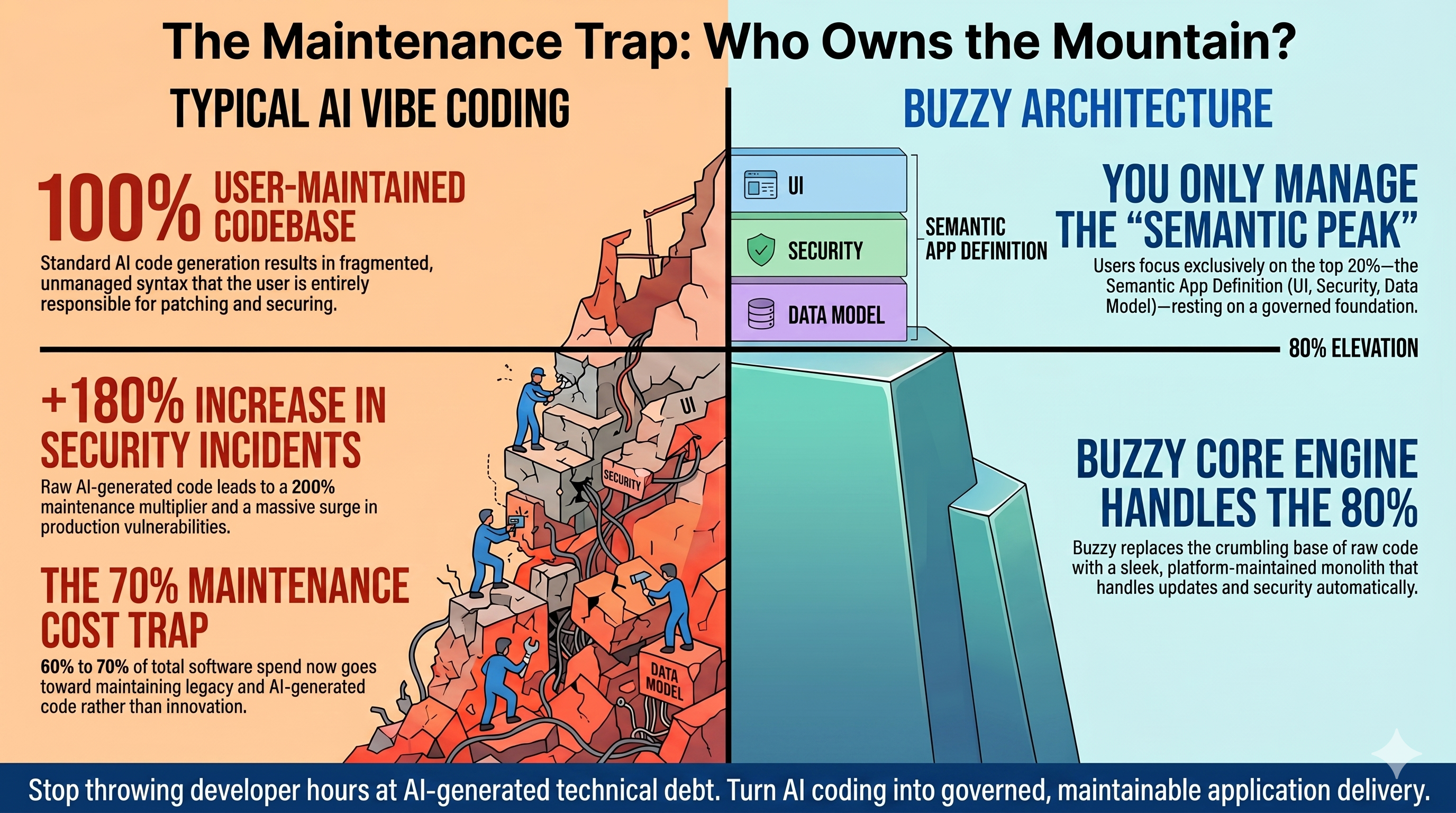
This is the trap illustrated in the attached mountain graphic. On the left side, the user owns the entire mountain: the collapsing base, the broken rock face, and the maintenance labour climbing all over it. On the right side, the user only works on the semantic peak — the application-specific layer such as UI, security intent, and data model — while a centralized core handles the heavy lifting below the line.
That framing matters because maintenance cost is not evenly distributed. Much of the real cost sits in shared runtime concerns: platform upgrades, security fixes, framework changes, cross-platform execution, compliance controls, and repetitive operational tasks that are largely the same across applications. If every app owns that burden independently, technical debt compounds. If a governed platform centralizes it, the cost curve flattens.
Buzzy’s Architectural Argument
Buzzy's positioning is that enterprises should not own 100% of the generated execution layer. Instead, they should manage a Semantic Application Definition: a structured description of the application that captures interface, workflows, security intent, and data model, while the Buzzy Core Engine handles the common runtime responsibilities.
That architecture is consistent across Buzzy's internal materials. The platform is described as producing production-ready web and mobile applications from a single semantic application definition, with platform-maintained code handled centrally rather than pushed into each customer's day-to-day maintenance load. The same materials position the core engine as the reusable foundation that absorbs updates, features, and security improvements across applications.
This is a fundamentally different ownership model. Instead of inheriting a sprawling generated codebase per app, the customer works at the semantic layer and only extends the platform where necessary through narrow custom code surfaces. In practical terms, that changes the shape of work: less low-level patching, fewer repeated upgrades, less duplicated architecture review, and a smaller compliance surface for each application team.
What That Looks Like in Practice
Task | Typical AI Code Generation | Governed Semantic Platform |
Architecture and review | Every app may require full inspection for quality, security, and maintainability. | Review concentrates on the semantic layer and approved extension points. |
Security patches | Teams must find and remediate vulnerable apps individually. | Core fixes can be handled once at the platform layer and propagated broadly. |
Platform upgrades | Framework or runtime changes often trigger per-app rework. | The governed core absorbs much of the upgrade burden centrally. |
Cross-platform delivery | Web and mobile divergence increases code ownership. | One semantic definition can drive multiple targets from one system. |
Buzzy's own comparison materials make this point directly: with conventional AI code generation, architectural review, maintenance, urgent patching, platform upgrades, and compliance each remain an application-by-application responsibility. In Buzzy's model, those recurring platform duties are substantially centralized, leaving the user to manage the higher-value application layer instead.
The strategic promise is not that code disappears. It is that the amount of code customers must directly own and continuously maintain becomes much smaller.
Why This Matters Now
The market is moving into a more serious phase. Early AI coding enthusiasm was driven by prototype velocity. Enterprise adoption, however, is shaped by a different buying logic: trust, governance, maintainability, and the ability to evolve without rebuilding every time the tooling stack changes.
Buzzy's internal executive summary argues that this is precisely the gap the company is built to fill: helping organizations capture AI-era delivery speed without inheriting the sprawling maintenance burden and governance exposure associated with unmanaged code generation. The same materials emphasize centrally managed updates, multi-platform deployment from one definition, and lower maintenance overhead as core differentiators.
That message also aligns with recent public cautionary examples. Reports involving Replit, Lovable, and Claude Code show that once AI-generated or AI-operated systems move closer to production, governance failures can become operational failures: exposed data, broken environments, or destructive actions that a human team must then unwind. [6][7][8]
The Better Framing for Enterprise Buyers
The wrong question is: can AI generate this app quickly? The better question is: who owns the mountain after generation?
If the customer owns the entire generated substrate, AI may accelerate delivery while also accelerating debt. If the customer owns only the semantic peak and the governed platform owns the heavy runtime foundation, AI becomes a force multiplier rather than a maintenance multiplier.
That is the essence of Buzzy's thesis. In a world of accelerating AI-generated software, the durable winners may not be the platforms that generate the most code. They may be the platforms that let enterprises ship faster while owning less of the maintenance burden.
Conclusion
AI code generation is changing software creation, but enterprise value will be determined by what happens after generation: maintenance, security, governance, extensibility, and cost of change.
Buzzy's semantic architecture presents a clear alternative to raw prompt-to-code sprawl. Instead of asking teams to maintain every generated artifact, it concentrates ownership at the semantic layer and shifts recurring runtime burden into a centrally managed core.
For organizations trying to move fast without creating tomorrow's legacy problem today, that may be the more important innovation.
Sources
[1] Gartner Says 75% of Enterprise Software Engineers Will Use AI Code Assistants by 2028
[3] GitClear: AI Copilot Code Quality - 2025 Look Back at 12 Months of Data
[4] METR: Measuring the Impact of Early-2025 AI on Experienced Open-Source Developer Productivity
[5] Veracode: AI-Generated Code Security Risks: What Developers Must Know
[6] SaaStr: Replit's New Release Addressed Most of The Challenges We Hit Vibe Coding