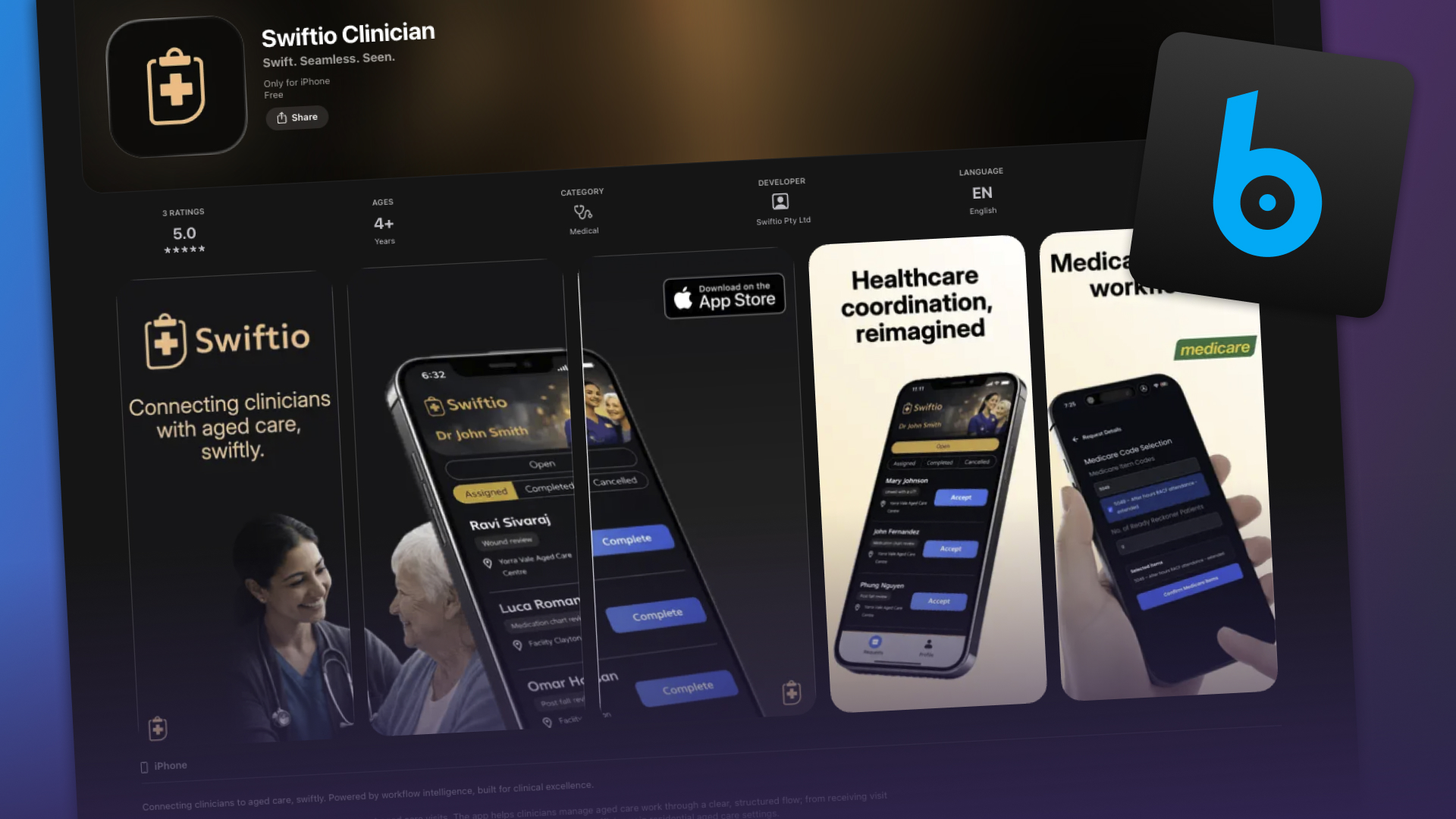
Swiftio: Connecting clinicians with aged care through one shared platform
- Dave Tanner
- 5 days ago
- 5 min read
Delivering a complex healthcare platform in minimal time and at minimal cost

Swiftio set out to create a shared healthcare platform that could serve different user groups across different devices: native mobile experiences for doctors, and web-based desktop and tablet access for nurses and facility staff.
The challenge was not only delivering a sophisticated product across web and mobile, but doing so quickly, cost-effectively, and in a way that would not burden the team with the ongoing technical debt that typically comes with traditional development or AI-generated codebases.
Using Buzzy, Swiftio was able to establish the original application foundation for more than 100 screens in under 4 days. That dramatically reduced the time and cost normally required to build a multi-platform product of this scale, and allowed the team to focus its effort on the business-critical functionality, security configuration, and launch requirements that mattered most.
The challenge
Healthcare solutions are inherently demanding.
They require secure workflows, multiple user experiences, support for different device types, and the flexibility to evolve over time. In Swiftio’s case, the platform needed to support doctors using a native mobile app, while nurses and facility staff accessed the system through web-based desktop and tablet experiences.
Traditionally, delivering this kind of solution would mean significant upfront investment just to establish the application layer across platforms — followed by ongoing maintenance overhead as infrastructure, frameworks, integrations, and security requirements changed over time.
Swiftio needed a faster, more capital-efficient way to deliver — without creating a long-term maintenance problem.
The approach
Buzzy enabled Swiftio to accelerate the earliest and most time-consuming phase of product
delivery by generating the original application foundation from design.
From more than 100 screens, Buzzy laid down the core infrastructure of the product in less than 4 days. That meant Swiftio did not need to spend months building baseline screens, navigation, structural logic, and platform scaffolding manually. Instead, the team could move rapidly into the higher-value work required before go-live.
This speed was made possible by Buzzy’s semantic application model.
Because Buzzy builds applications from Semantic App Definitions, the product definition is separated from the underlying technology implementation. That abstraction is what enables Buzzy to generate and support both web and mobile experiences from the same core definitions, rather than requiring separate codebases and duplicated development effort.
For Swiftio, that meant one product definition could support a native mobile experience for doctors and web-based desktop and tablet experiences for nurses and facility staff — all from the same underlying application model.
Where the value was created
The real value was not just in faster initial delivery. It was in where Swiftio’s time and budget could now be spent.
Because Buzzy established the application foundation so quickly, the development team was free to focus on the parts of the solution that required real technical judgment and business understanding:
critical business functionality
security setup and platform hardening
architecture decisions aligned to operational needs
launch-critical requirements across user groups and devices
Rather than using valuable developer time to recreate foundational layers manually, Swiftio could direct effort to the areas that differentiated the product and supported readiness for deployment.
A platform advantage, not just a build shortcut
A major advantage for Swiftio was that Buzzy did not simply help generate the initial product — it also shielded the team from a significant class of ongoing technical debt.
During a critical phase of delivery, Swiftio benefited from improvements made at the platform level without needing to absorb the engineering cost directly. Critical security fixes and patches were applied within Buzzy itself, with no implementation effort required from the Swiftio team.
This reduced one of the most persistent sources of technical debt in modern application delivery: the burden of continually updating and maintaining the underlying generated codebase.
This is a key difference between Buzzy and typical AI code generation approaches.
With conventional AI-generated code, teams often inherit the responsibility of maintaining and updating that generated output over time. In practice, that can create a growing technical debt burden as frameworks evolve, security issues emerge, and infrastructure standards change.
With Buzzy, those improvements are handled at the platform level. Swiftio benefits from the evolution of the platform without having to repeatedly refactor, patch, or maintain large volumes of generated application code themselves.
Built to evolve
This platform model also gave Swiftio a future-proof path forward.
New capabilities introduced into Buzzy — including support for Auth0, MCP, and ongoing improvements to the SCM development-to-production workflow — became available to Swiftio without requiring the team to independently design, build, and maintain those capabilities from scratch.
That changes the economics of product evolution.
Instead of carrying the full cost of every new infrastructure capability or platform enhancement, Swiftio can adopt and enable those innovations when ready, while continuing to benefit from improvements being made across the broader Buzzy platform.
In practical terms, that means Swiftio is able to move with many of the advantages associated with AI and no-code development — speed, leverage, and flexibility — without carrying the same technical debt hangover that usually follows.
The outcome
Swiftio delivered a sophisticated healthcare platform across web and mobile with a fraction of the time, cost, and engineering overhead typically required for a project of this scale.
Buzzy laid down the original foundation in under 4 days, enabling rapid delivery of the core application structure across more than 100 screens. From there, Swiftio could focus on the functional, operational, and security requirements most important to the business.
Just as importantly, Swiftio was not left maintaining a fragile generated codebase. By building on Buzzy’s semantic platform architecture, the team gained a more durable foundation — one that continues to benefit from platform-level fixes, enhancements, and new capabilities over time.
The result was not only faster delivery, but a more sustainable path to ongoing product development.
Why it matters
For teams building complex products, speed alone is not enough.
The real question is whether you can move quickly without creating a maintenance burden that slows you down later.
Swiftio’s case shows what that looks like in practice:
rapid delivery of a multi-platform application foundation
lower upfront build cost
more developer time focused on business-critical functionality
reduced exposure to traditional technical debt
access to ongoing platform improvements without repeated redevelopment effort
Buzzy did not replace the development team. It removed unnecessary delivery overhead, separated product definition from technology implementation, and gave Swiftio a platform that could continue to evolve without dragging the team into constant rework.
Key results
Foundation for 100+ screens laid down in under 4 days
Support for native mobile for doctors and web-based desktop/tablet access for nurses and facility staff
Significant reduction in delivery time and upfront cost
Product built from Semantic App Definitions, enabling multiple platforms from the same core definitions
Reduced exposure to traditional technical debt
Security patches and platform fixes delivered through Buzzy with no additional effort from Swiftio
Access to new platform capabilities such as Auth0, MCP, and SCM dev-to-production improvements without separate implementation cost
A more future-ready delivery model than traditional AI-generated codebases
SwiftioDelivering a multi-platform healthcare solution without the usual time, cost, and technical debt
Built faster. Maintained easier. Ready to evolve.
For more information on how Buzzy can transform your feedback solutions, see more of Buzzy's Case Studies.
More information:
Swiftio: https://www.swiftio.ai/
Buzzy: www.buzzy.buzz


