
Artificial intelligence has moved from boardroom curiosity to enterprise mandate.
CEOs are asking how quickly AI can change the business. Boards are asking whether the organization is moving fast enough. Business units are experimenting with copilots, agents and automation. Developers are generating more code in less time. Technology teams are being asked to turn all of this activity into measurable business value.
For CIOs, the challenge is no longer whether to adopt AI. The challenge is whether the enterprise can move from AI experimentation to production-grade execution.
That gap is becoming impossible to ignore. In Gartner's 1H26 CIO Report, 72% of CEOs identify AI as their primary driver of growth, 83% are increasing investment in AI, 71% of CIOs struggle to prioritize the use cases that will deliver measurable business outcomes, and 59% of AI initiatives fail to make it into production.
That is the enterprise AI execution gap: the distance between a promising pilot and a production system, between an impressive demo and a governed application, between AI activity and enterprise value.
The problem is not starting AI. It is scaling AI.
Most organizations have already started. Teams are using AI assistants. Business units are experimenting with automation. Developers are using AI code generation. Operations teams are exploring workflow optimization. Product teams are testing new customer experiences.
The problem is that much of this activity remains fragmented. One team builds a proof of concept. Another experiments with a different tool. A third creates a workflow that depends on a specific model, spreadsheet or integration. Some initiatives show promise, but few are hardened, governed, measured and scaled.
This is where the pilot-to-production gap appears. A pilot can succeed in a controlled environment because it is narrow, isolated and often lightly governed. Production is different. Production requires security, compliance, integration, reliability, cost control, ownership, monitoring and ongoing support.
The pilot proves what is possible. Production proves what is valuable.
Gartner's guidance is clear: CIOs must shift from fragmented AI pilots to a unified enterprise platform that eliminates bottlenecks and enables scalable value delivery. AI must also be treated as a living product that is continuously monitored, refined and improved rather than as a one-off experiment.
Why AI pilots fail to reach production
1. Too many experiments, not enough prioritization
AI has created a flood of possible use cases. Every department can imagine ways to automate, accelerate or augment work. That creates excitement, but also noise.
Without a clear prioritization model, organizations end up with dozens of pilots competing for attention, budget and executive sponsorship. Some are technically interesting but commercially weak. Others are valuable but too complex to deploy. Many lack a clear business owner.
This is why Gartner's finding that 71% of CIOs struggle to prioritize AI use cases matters so much. The issue is not a shortage of AI ideas. It is a shortage of disciplined selection.
Which use cases are tied to measurable cost, revenue, risk or productivity outcomes?
Which can be deployed into real workflows?
Which can scale across multiple teams or business units?
Which can be governed safely?
Which are worth maintaining over time?
AI strategy cannot be a long list of experiments. It needs to become a portfolio of value-backed initiatives.
2. Fragmented tools create fragmented outcomes
The first wave of enterprise AI adoption has often happened tool by tool: a coding assistant here, a chatbot there, a workflow automation platform somewhere else, a business unit experimenting with an app builder, a team calling a model directly through an API.
This bottom-up experimentation is useful for learning, but it creates fragmentation when organizations try to scale. Different teams use different tools. Data is handled inconsistently. Security standards vary. Reusable patterns are missed. Costs become opaque. Governance becomes manual.
For CIOs, the strategic question becomes: what is the common platform layer that allows the enterprise to build, govern, deploy and improve AI-enabled applications consistently?
3. Governance is applied too late
Many AI pilots are built to show speed. Governance often arrives later. That sequence creates problems.
A prototype may work in a controlled environment, but production introduces harder questions. What data does it access? How are permissions enforced? How is output monitored? Who owns the risk? How does the organization audit changes? How are privacy, security and compliance requirements embedded?
When these questions are answered late, the pilot slows down or stalls. Security teams raise concerns. Legal wants review. Architecture teams identify integration issues. Finance asks for ROI. Operations asks who will support it.
The issue is not that governance blocks innovation. The issue is that governance was not designed into the delivery model from the beginning.
4. AI-generated code creates a new maintenance problem
AI code generation has changed the economics of software creation. It is now possible to generate interfaces, workflows, integrations and application logic faster than ever before. But faster code generation does not automatically create better enterprise systems.
In fact, speed can hide a growing maintenance burden. What looks like a fast win during prototyping can become a long-term operational liability if the result introduces inconsistent architecture, duplicated logic, insecure defaults, fragile integrations or code that is difficult for teams to understand or extend.
Enterprise value is not created when code is generated. It is created when systems are deployed, adopted, maintained and improved.
The pressure stack facing CIOs
The execution gap is becoming more urgent because CIOs are facing pressure from three directions at once.
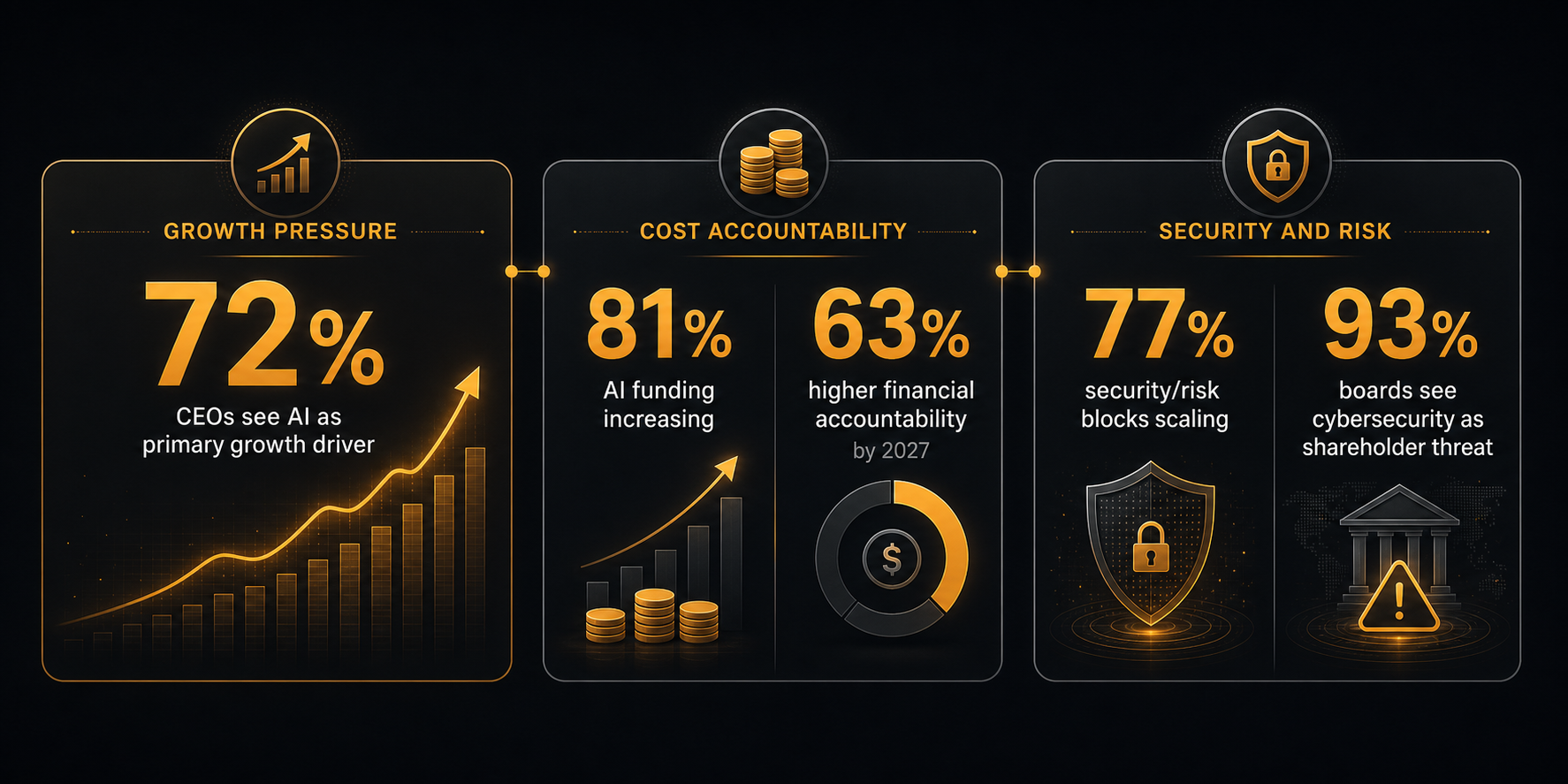
Growth pressure: Gartner reports that 72% of CEOs identify AI as their primary driver of growth.
Cost accountability: Gartner reports that 81% of enterprises plan to increase AI funding in 2026, while 63% of CIOs expect the bar for financial accountability to rise by 2027.
Security and risk: Gartner reports that 77% of CIOs cite security and risk as the biggest barriers to scaling autonomous technologies, and 93% of nonexecutive board members view cybersecurity as a threat to shareholder value.
CIOs are being asked to scale AI faster, prove ROI sooner, control cost more tightly and reduce risk more visibly. Traditional AI code generation helps with speed, but speed alone does not solve the execution gap. In some cases, it can make governance, cost control and maintenance harder.
Closing the execution gap requires a new operating model
Move from projects to platforms
AI should not be managed as a loose collection of isolated initiatives. It needs a platform strategy with shared foundations for governance, deployment, monitoring, security, integration and lifecycle management.
Measure outcomes, not activity
Number of pilots, prompts and generated apps is easy to count. CIOs need to measure outcomes instead: reduced cost, increased revenue, improved productivity, lower risk, faster delivery, better customer experience and lower maintenance load.
Treat AI applications as living products
Models will change. Regulations will evolve. Business processes will shift. Security threats will increase. User expectations will rise. AI applications need ongoing ownership, monitoring, refinement, testing, governance updates and continuous improvement.
Separate business intent from technical debt
One of the most important architectural questions for the AI era is whether the enterprise can capture application intent without locking itself into unnecessary code complexity.
This is where semantic application models become strategically relevant. Instead of treating generated code as the primary asset, a semantic application approach captures the structure of the application: data, workflows, UI, logic, security and integration patterns. That definition can then be executed through a governed platform layer.
For CIOs, the appeal is not just speed. It is control.
The missing layer between AI promise and enterprise production
The first phase of AI adoption has been about capability: what can AI generate, automate and accelerate? The next phase will be about operationalization: how to make AI outputs secure, governed, integrated into real workflows, maintainable, scalable and measurable.
This is where many organizations will discover that AI code generation alone is not enough. The enterprise needs a system layer that turns AI-generated intent into governed applications.
Buzzy is built around this idea. Rather than generating large, fragmented codebases for every application, Buzzy generates a semantic application definition that runs on a centrally managed core engine. That approach is designed to help organizations turn prompts and designs into governed, production-ready web and mobile applications while reducing the maintenance burden associated with fragmented AI-generated code.
In other words, Buzzy is not just about faster app creation. It is about helping enterprises close the execution gap between AI ambition and production-grade application delivery.
The CIO mandate
The winners in enterprise AI will not be the organizations that run the most pilots. They will be the organizations that close the execution gap fastest. They will prioritize the right use cases, create shared platforms, embed governance early, measure business outcomes, treat AI systems as living products and avoid creating a new generation of technical debt in the rush to move quickly.
For CIOs, this is the real mandate: turn AI ambition into production systems that create durable business value.
Want to discuss what that could look like in practice? Book a meeting with Buzzy to discuss further, or visit www.buzzy.buzz to explore the platform.
Reference
Gartner, The CIO Report: 1H26, including the sections on responsibly scaling GenAI, managing AI cloud costs and strengthening cybersecurity. Related Gartner article: CIO Challenges: How to Responsibly Scale GenAI, Manage AI Cloud Costs and Strengthen Cybersecurity.