
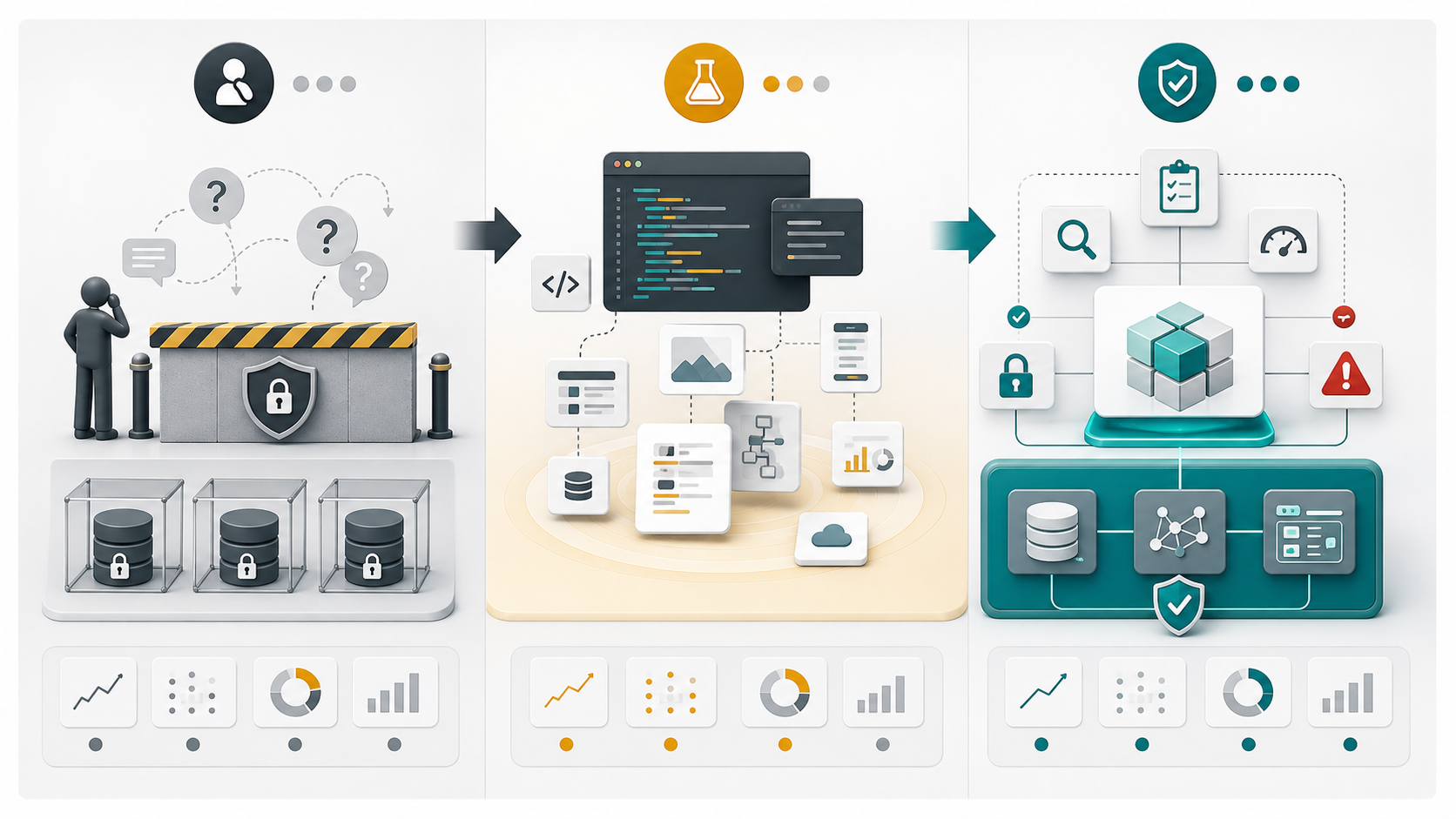
After speaking with enterprise teams about AI, a clear pattern is emerging. The market is not moving as one group. It is separating into three postures.
The first group is still sitting on the fence. They can see the opportunity, but governance, security, privacy, procurement and internal risk processes are holding them back. This is understandable, but it is becoming more dangerous. Waiting is not a neutral position when competitors, employees and shadow AI workflows are already moving.
The second group is experimenting. They are using AI code generation, copilots, prototypes and internal tools, often with enthusiasm but without a fully mature operating model. This group should keep playing, testing and learning. The more they use AI seriously, the more clearly they see both sides of the truth: AI is extraordinary, and it still has major gaps around quality, security, maintainability, workflow fit and production ownership.
The third group is more advanced. They have been through code generation, have shipped experiments, and now understand the hard parts: technical debt, code quality, security review, governance, ownership and long-term maintenance. This is the group where Buzzy is the most direct fit, because they already know the problem is not simply generating more code. The problem is turning AI speed into governed, maintainable business systems.
That pattern matters because each group needs a different conversation. The fence-sitters need a controlled way to begin. The experimenters need space to learn where the gaps are. The mature adopters need a new delivery model: one that keeps AI speed without inheriting a mess of code, apps and risk.
The research supports what enterprises are saying
This is not just anecdotal. McKinsey's 2025 State of AI survey found that 88% of respondents reported regular AI use in at least one business function, but nearly two-thirds of organizations had not yet begun scaling AI across the enterprise. That is exactly the split many enterprise conversations reveal: AI is being used, but scaled operating models are still immature.
Deloitte's enterprise generative AI research shows the same gap from another angle. More than two-thirds of respondents said that 30% or fewer of their generative AI experiments would be fully scaled in the next three to six months. The issue is no longer whether teams can create AI experiments. The issue is whether those experiments can become dependable business systems.
IBM's 2025 Cost of a Data Breach research explains why the first group is nervous. IBM reported that 63% of organizations lacked AI governance policies to manage AI or prevent shadow AI, and that 97% of organizations reporting an AI-related security incident lacked proper AI access controls. Those are not theoretical blockers. They are board-level concerns.
For the code-generation side of the story, Stack Overflow's 2025 Developer Survey is useful. It found that 84% of respondents use or plan to use AI tools in development, while 46% do not trust the accuracy of AI output. It also found that 66% of developers named AI solutions that are almost right, but not quite as their biggest frustration, and 45% said debugging AI-generated code is more time-consuming. That is the mature adopter's problem in data form: the first draft got faster, but ownership did not disappear.
Group 1: Sitting on the fence
The first category is the enterprise that knows AI matters but has not meaningfully adopted it. These teams are often not anti-AI. They are blocked by responsible concerns: data privacy, cybersecurity, legal review, procurement policy, model risk, explainability, regulatory exposure and uncertainty about who owns the outcome.
This group is often described as slow, but that is not always fair. In regulated or complex organizations, the cost of getting AI wrong can be material. If an AI tool exposes customer data, generates incorrect advice, changes records without auditability or produces code nobody can support, the downside is real.
The fence-sitter's core question is not, "Is AI useful?" It is, "Can we use AI without losing control?"
That question needs a practical answer. These organizations need a path that starts with governed, bounded, reviewable workflows. The right first project is rarely a broad autonomous agent. It is usually a narrow internal workflow with clear ownership, clear data boundaries and a measurable business outcome.
The risk for this group is that sitting still can feel safer than it really is. The organization may avoid official AI adoption while employees quietly use consumer tools, teams create unofficial prototypes, and competitors build institutional learning. At some point, the cost of not learning becomes greater than the risk of starting carefully.
Buzzy has a role here, but it is not the most urgent category fit. For fence-sitters, the value is a safer entry point: start with a structured app, defined data, bounded workflows and clearer governance rather than unmanaged AI experimentation.
What fence-sitters should build first
The safest starting point is an app or workflow that:
uses non-sensitive or permission-controlled data
has a named business owner
has a clear approval or review step
can be measured against cycle time, cost or quality
does not require the AI to make irreversible decisions
Good examples include internal request intake, staff onboarding, policy lookup with human approval, lightweight reporting, customer inquiry triage or a controlled operations dashboard. These are not glamorous use cases, but they build organizational confidence.
Group 2: Playing with it
The second category is experimenting. These teams are dipping toes in the water with coding assistants, generated prototypes, internal tools, chatbots, workflow automation and productivity hacks. They have moved past debate and into learning.
This stage is useful. The right advice for this group is simple: play, play, play, but do it deliberately. Experimentation teaches teams where AI is strong and where it struggles. It also creates momentum. A team that can build a working prototype in days starts asking better questions about product, workflow and automation.
The point of this stage is not to pretend AI is perfect. It is to learn where the gaps are. Teams begin to see that AI can generate a first draft, but the first draft may still have fragile assumptions, shallow error handling, inconsistent implementation, missing controls, poor edge-case coverage and unclear ownership. That learning is valuable. It gives the organization a practical map of what AI can accelerate and what still needs a governed delivery model.
But experimentation has a predictable failure mode: scattered wins become scattered systems. One team builds a lead tracker. Another generates a support tool. A third creates a reporting assistant. A fourth ships a prototype that quietly becomes operational. Six months later, nobody has a clean view of what exists, who owns it, how it authenticates, what data it touches or how it gets updated.
This is the beginning of AI app sprawl.
The experimenter's risk is mistaking demos for systems
A demo proves possibility. A system proves reliability. The difference is governance, identity, data quality, environment control, monitoring, change management and support ownership.
Many teams in this second group are using code generation because it feels like the fastest route to a working result. Sometimes it is. But generated code often moves faster than the surrounding operating model. If each experiment becomes its own codebase, the organization inherits many small maintenance obligations at once.
The practical advice for this group is to keep experimenting, but change what gets measured. Do not only count how fast the prototype was created. Count how easily it can be secured, reviewed, deployed, updated and retired.
Buzzy's role for this group is to help turn learning into structure. Once teams understand the gaps in raw AI code generation, Buzzy gives them a way to keep the speed while moving toward a semantic app definition, governed deployment and a clearer production model.
Group 3: Mature, experienced and the strongest Buzzy fit
The third category is the most interesting. These are teams that have already used AI code generation seriously. They are not skeptical because they are behind. They are skeptical because they have experience.
They have seen AI generate code that works on day one but becomes difficult to extend. They have seen duplicated patterns, inconsistent architecture, shallow tests, fragile integrations, unclear ownership and security questions that arrive late. They have learned that code generation is not the same as application delivery.
This is where the enterprise conversation changes. Mature teams are no longer asking whether AI can create software. They know it can. They are asking whether AI-created software can be governed, maintained, secured and improved without compounding technical debt.
This is the category Buzzy is built for. These teams already understand the gotchas. They have felt the maintenance burden. They have seen how quickly code generation can create a portfolio of small apps that need review, patching, security hardening, documentation, ownership and support. They are ready for a more durable abstraction.
The real maturity shift: from generated code to governed intent
The most mature teams are starting to separate business intent from implementation burden. They still want AI speed. They still want rapid prototyping. They still want business users and product teams to describe what they need in natural language or design tools. But they do not want every new idea to produce another standalone codebase that must be audited and maintained forever.
This is where semantic application definitions become strategically useful. Instead of treating generated code as the primary asset, the app is represented as structured intent: screens, data, workflows, permissions, logic and integrations. That definition can then run on a governed platform layer.
The difference is important. Code generation optimizes for creation. A semantic platform optimizes for creation plus operation.
Why this is Buzzy's moment
Buzzy fits this enterprise reality, but the fit is strongest in category three.
For fence-sitters, Buzzy offers a controlled way to start with structured apps rather than unmanaged AI experiments. The message is that jumping in carefully may now be safer than waiting indefinitely.
For experimenters, Buzzy gives a faster path from idea, prompt or design into a working app without making every pilot a separate codebase. The message is to keep playing, keep learning and pay close attention to where AI-generated code starts to crack under production expectations.
For mature adopters, Buzzy addresses the painful lesson they have already learned: the long-term value is not in generating more code, but in building systems that remain governable after the demo. This is where the semantic app definition approach becomes key. It lets teams capture business intent, data, workflows, roles and logic as a structured application model, instead of pushing every new AI idea into another raw codebase with its own debt profile.
The market is moving from "can AI build this?" to "can we run this safely?" That is the right question. Enterprises do not need more magic demos. They need a delivery model that turns AI ambition into production systems with less technical debt, clearer governance and a lower maintenance burden.
A simple way to diagnose where your enterprise is
Ask five questions:
Adoption: are teams using AI in real work, or mostly discussing policy?
Inventory: do you know which AI-built tools and prototypes already exist?
Ownership: does every AI app have a business owner and technical owner?
Control: can you explain what data each app touches and who can access it?
Maintenance: do new AI-built apps reduce workload, or create more code to support?
If the answer to most of those questions is unclear, the next priority is not another proof of concept. It is an operating model.
The bottom line
Enterprise AI adoption is no longer a simple maturity curve. It is a set of postures shaped by risk tolerance, experimentation, and hard-earned lessons from early adoption.
Category one needs to start learning before waiting becomes the larger risk. Category two needs to keep experimenting until the gaps are visible. Category three is where Buzzy is the sharpest fit: teams that already understand the gotchas and now need a governed semantic app-definition model to keep AI speed without multiplying technical debt.
The winners will not be the organizations that generate the most code or run the most pilots. They will be the organizations that turn the right workflows into governed, maintainable, production-ready systems.
Want to discuss what that could look like in practice? Book a meeting with Buzzy to discuss further, or visit www.buzzy.buzz to explore the platform.