How AI becomes operational when it can work inside your real business systems
The Big Idea
A lot of "AI future" talk is converging on the same point: AI becomes genuinely powerful only when it can work inside your Systems of Record (SoR)—the apps where real business data and work live (CRM, support, billing, docs, messaging, etc.).
Some people call the connective layer between these systems and AI "context graphs." The label is new-ish, but the problem isn’t: critical context is currently fragmented across disparate tools, documents, and people’s heads. Thanks to the folk at FoundationCapital for your inspiration here.
Why Context is the Bottleneck
Even strong teams struggle with the "context gap." Valuable information is trapped in:
Tribal knowledge: The "why we did that" rationale that lives only in humans.
Imperfect memory: Lost details of past decisions.
Siloed systems: A complete picture requires synthesizing data from CRM, Support, Email, Slack, and Analytics.
Uncaptured work: Tasks that are too slow or awkward to log manually.
The next leap in software isn’t "AI that writes faster." It’s AI that understands your real-world state and helps you act on it.
The Shift: From AI Suggestions to AI Actions
Until recently, AI could give advice but couldn’t do the work. It lacked access to your System of Record and couldn’t safely operate with your permissions.
Now, with MCP-style connectivity (Model Context Protocol) and AI app integrations, we’re entering a world where Human + AI + SoR enables operational superpowers. We are moving from a "read-only" relationship with AI to one where it can turn data into actions in minutes.
A Simple Example: The "Vibe Coded" CRM
To make this tangible, let's look at a CRM. It is the classic System of Record for most companies.
In the demo (see below), I "vibe coded" a fully functional CRM—web and mobile—from a single prompt. It included a dashboard, Kanban deal stages, customers, notes, tasks, and a backend database. While the build speed was impressive, the real breakthrough was making the CRM available to AI as a set of tools.
Tools: How AI Interacts with Your System of Record
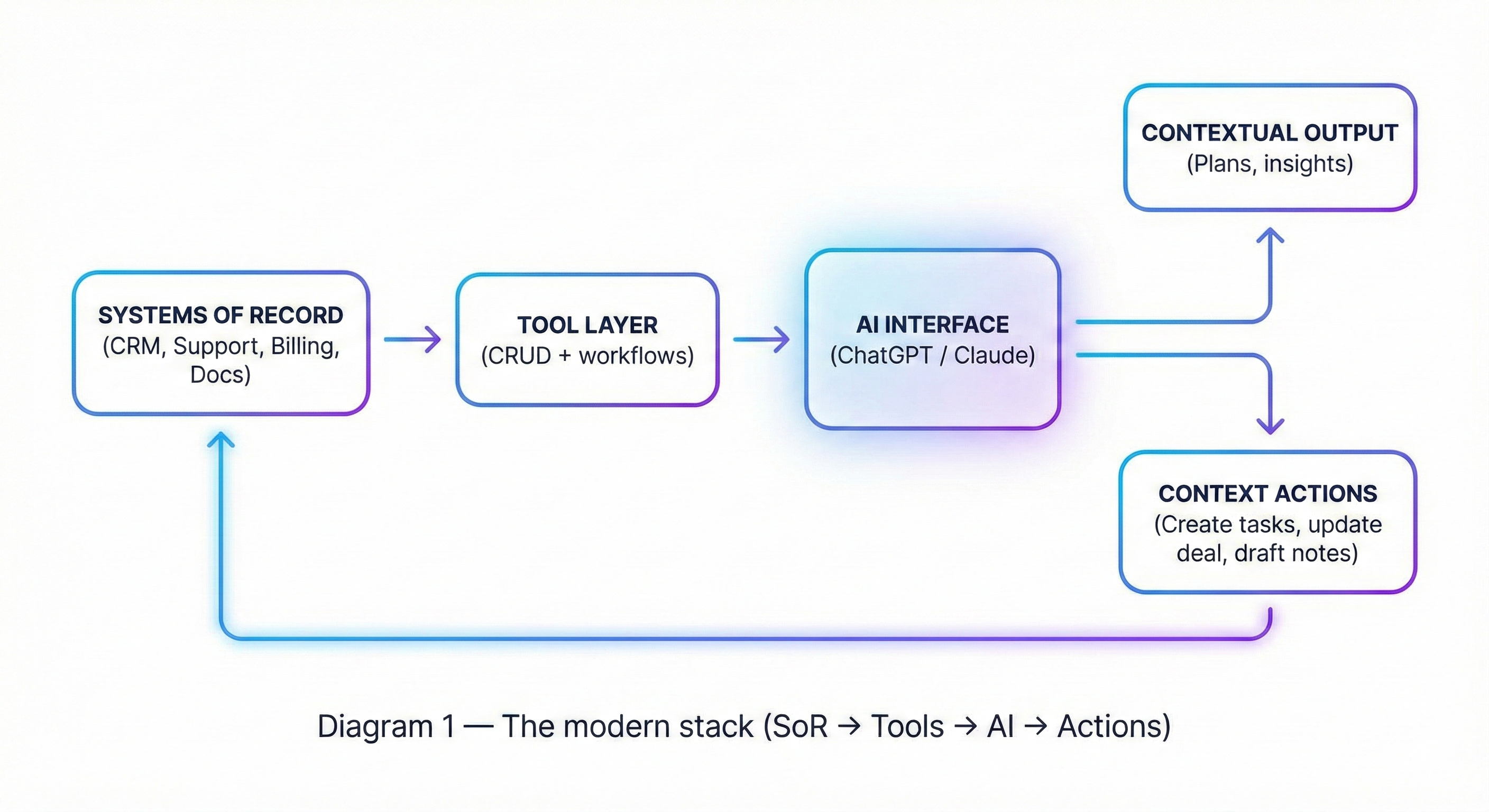
Once your SoR exposes capabilities as tools, an AI can move beyond chat. It can pull specific deal notes, create follow-up tasks, update owners/deadlines, or batch-create entries.
There are two practical categories of tools:
Invisible Tools (No UI): AI reads/writes in the SoR behind the scenes (e.g., calling an API to update a status).
Tools with Widgets: Small embedded UI panels for review/approval, quick edits, or transparency.
The Modern Stack:
Security: Acting "As the User"
In real organizations, the only viable model is OAuth-based authentication where the AI acts as the logged-in user. Permissions and roles must be enforced by the System of Record, not the AI. This ensures that if a user can't delete a deal in the dashboard, their AI agent can't do it either.
Context Actions: The Superpower
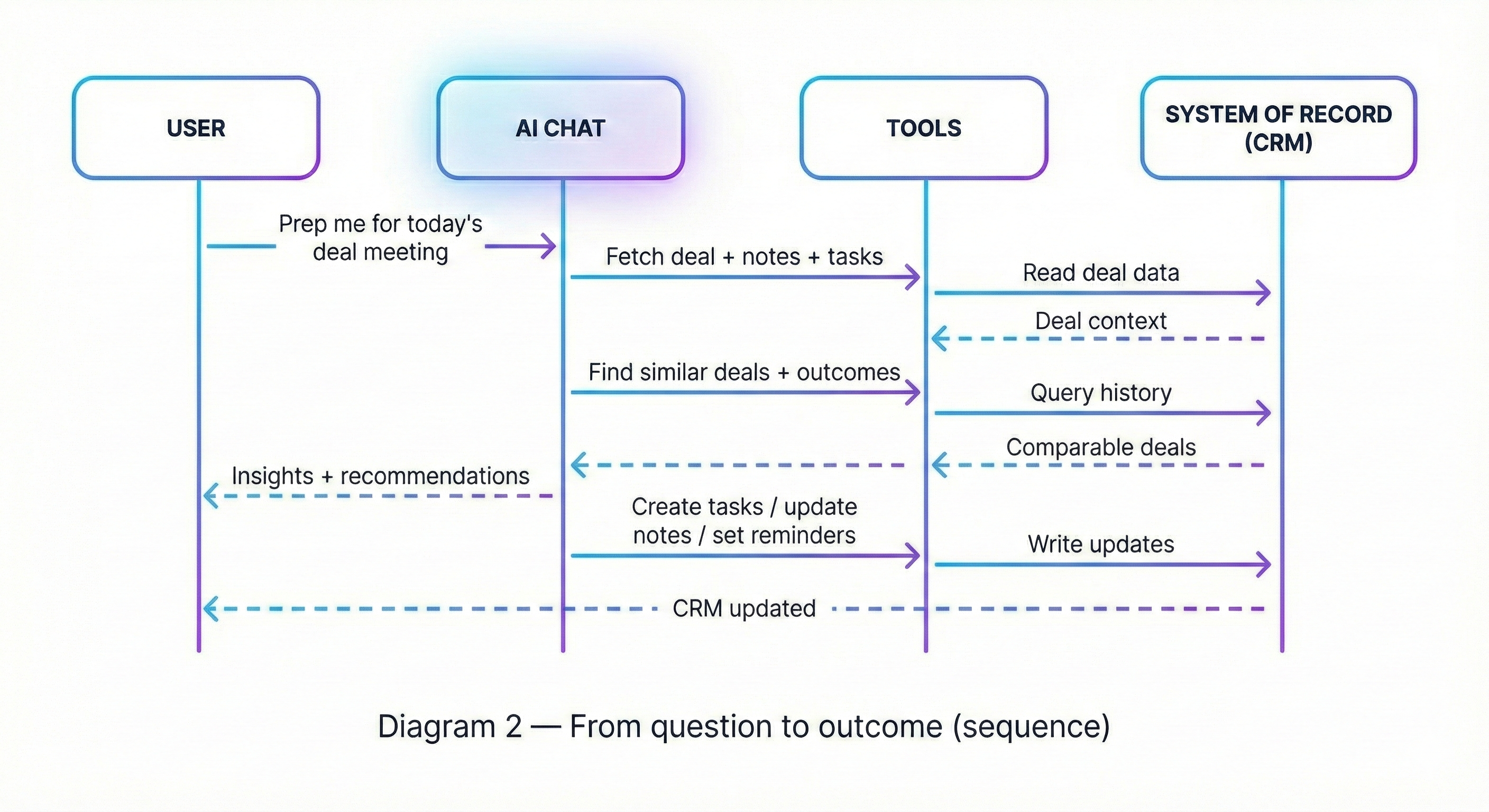
Here’s a realistic workflow: You’re in ChatGPT before a customer meeting. You ask it to pull the full deal context, compare it to similar past deals, and suggest a closing strategy.
If the AI has access to your Context Graph and SoR, it can:
Read the deal notes and history.
Query the database for similar outcomes.
Draft next-step tasks and meeting prep.
Update the CRM automatically so no action is lost.
From Question to Outcome:
What This Means for Builders
If you build software, your roadmap needs to change. It’s no longer just about "what screens do we ship next?" You must ask:
What capabilities do we expose as tools?
How do we structure a "Context Graph"? (Tip: Treat the graph as a derived cache, not the source of record. Keep writes append-only to preserve history).
Which actions should be invisible vs. widgeted?
How do we design workflows where AI safely handles the boring steps?
The Takeaway: Start Small, Learn Fast
This space is moving quickly. The competitive advantage won’t come from guessing the perfect architecture on day one. It will come from running a small Proof of Concept (POC) that teaches you what "good tools" look like, where context is missing, and which workflows users actually trust.
You don’t need a massive digital transformation program. You need a wedge.