The AI Prototype Paradox
The software industry is currently intoxicated by the magic of "prompt-to-app" tools. We are witnessing a phase where anyone can talk an idea into existence in seconds, a phenomenon that feels like a superpower. However, for the seasoned product strategist, this speed masks a profound architectural trap: the AI Prototype Paradox.
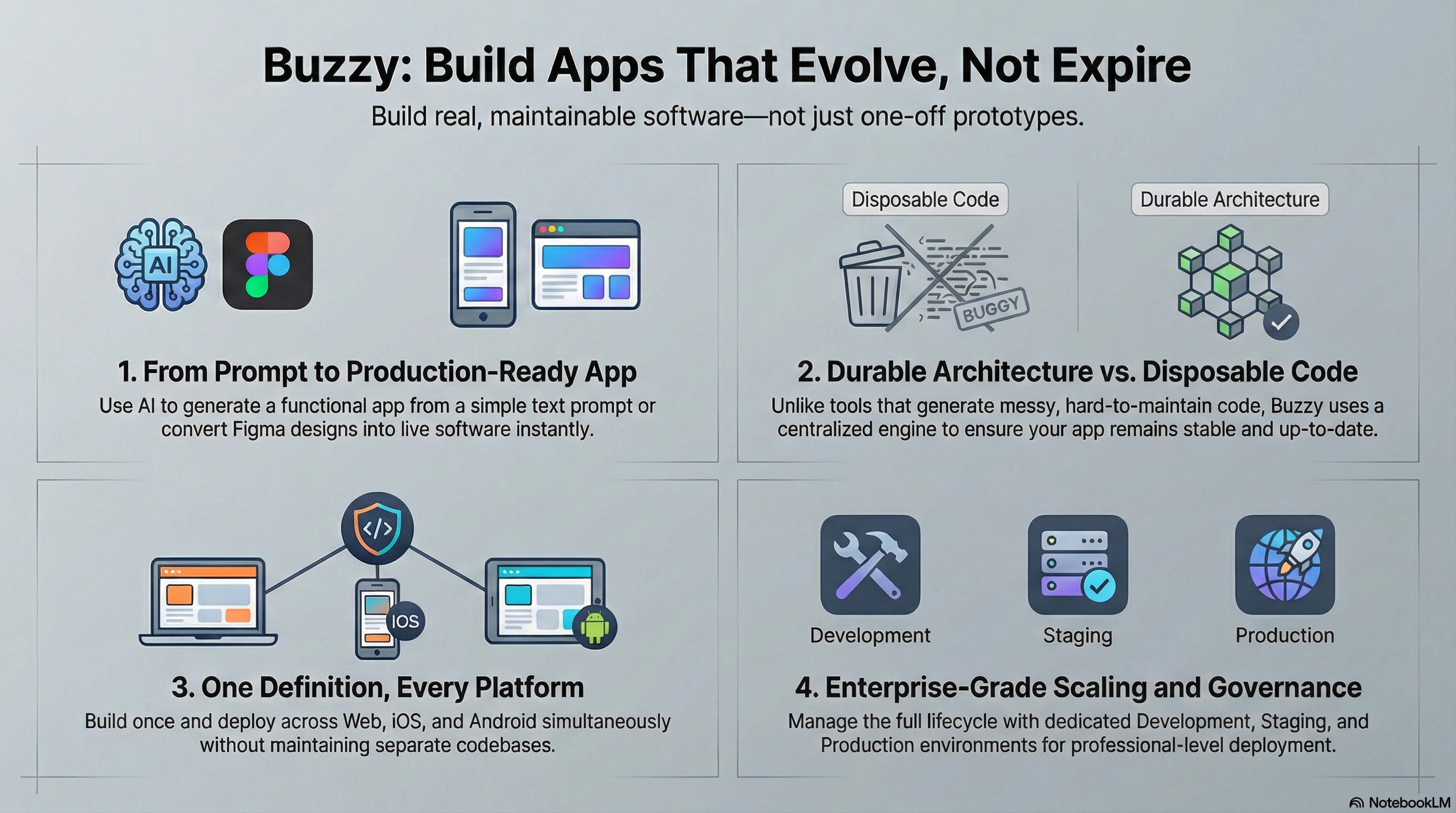
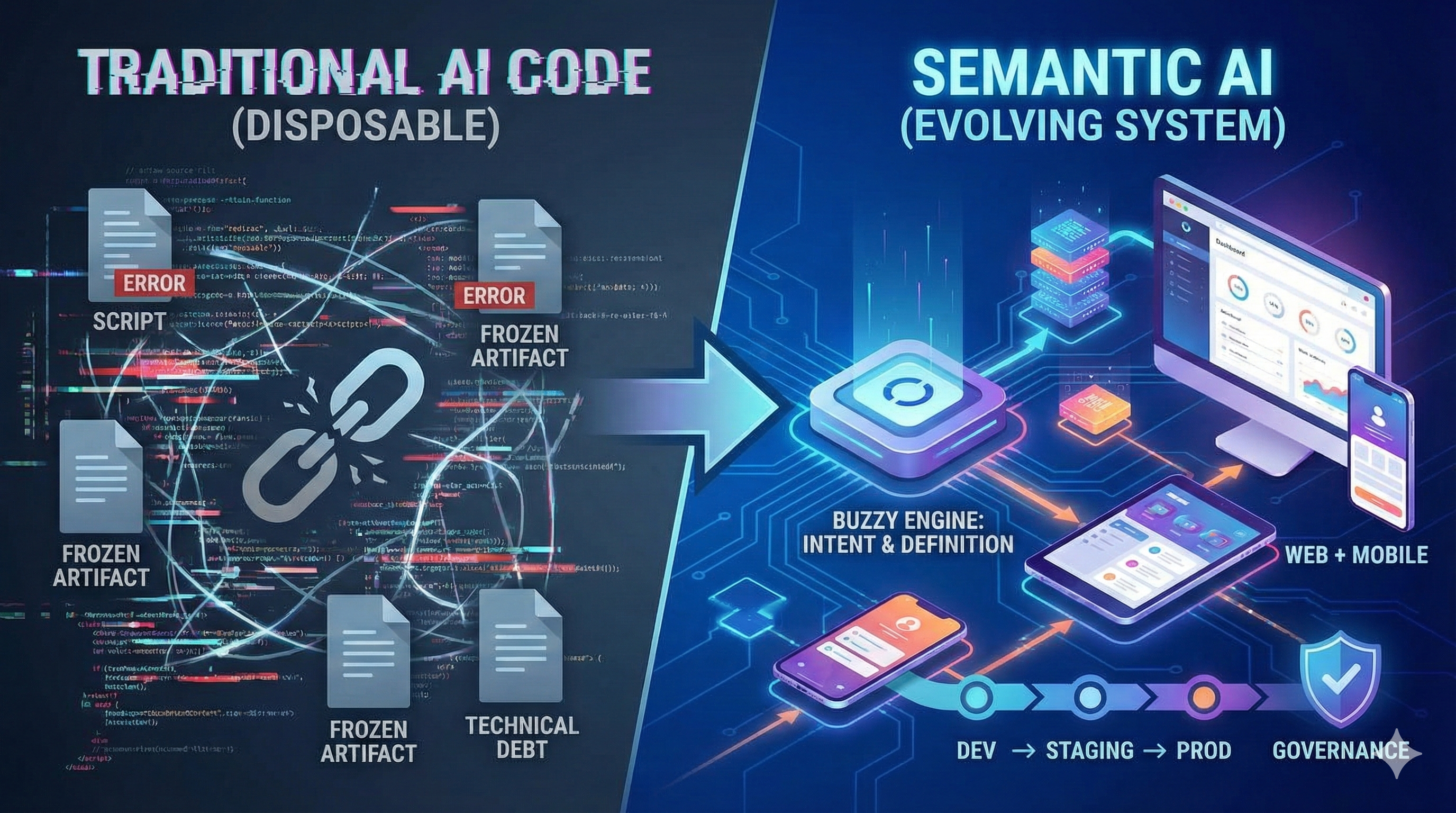
The paradox is simple: the faster you generate an app using raw AI-generated code, the faster you create technical debt. These tools produce architecturally inconsistent point-in-time artifacts—codebases that are "frozen" the moment they are generated. In the enterprise, speed without durability is a strategic failure. Buzzy is shifting this paradigm by moving away from fragile, one-off code generation toward "semantic applications": structured application definitions that run on a centralized engine, designed to evolve rather than expire.
Takeaway 1: Stop Building Disposable AI Code
The fundamental flaw in traditional AI code generation is that it treats software as a collection of text files to be written once and managed forever. This results in unique, messy outputs that require a developer to understand, maintain, and eventually rewrite.
Buzzy treats software as a system, not a script. By separating the application definition from the runtime engine, Buzzy ensures that you are managing business logic and outcomes, not raw source code.
Build Real Software — Not Disposable AI Code. AI can now generate software in seconds. But speed alone doesn’t build durable systems. Buzzy is true AI-powered no-code that delivers full working web and mobile applications — without generating fragile, one-off codebases.
For non-developers and innovation teams, managing a structured system is infinitely superior to managing raw files. When the "engine" owns the runtime, the architectural integrity remains stable regardless of how many times you iterate on the front end.
Takeaway 2: The "Vibe Coding" Reality Check
"Vibe Coding" is the ultimate lowering of the barrier to entry—the ability to move from idea to application in minutes simply by describing a vision. As no-code guru Max Mirho puts it: "You're just talking ideas to an AI and it builds what you want and that's super super powerful!"
However, a strategist must account for "Vibe Debt." If your "vibe" results in a tangle of Javascript you can't untangle, you've gained nothing. Buzzy facilitates the speed of vibe coding while enforcing the rigor of a professional-grade backend. You focus on the intent and the user experience; the Buzzy engine ensures those ideas are translated into a functional, full-stack architecture that won't break when the "vibe" changes.
Takeaway 3: One Definition, Two Worlds (Web + Mobile)
In an era of fragmented device usage, "platform drift" is a primary cause of integration nightmares. Traditional AI tools often require you to prompt separate codebases for web and mobile, leading to fragmented data and inconsistent logic.
Buzzy utilizes a "One System, One Definition" architecture where the application definition acts as the single source of truth. Consider a hospital environment:
Doctors require high-performance mobile apps for bedside care.
Admin staff require dense browser-based dashboards for resource management.
Operations rely on the shared system of record to ensure data integrity across the board.
Because there is only one definition, there is no duplication of effort. You can deploy across three distinct paths simultaneously:
Web applications for immediate browser access.
Native iOS and Android apps for mobile-first utility.
App Store publishing through automated, standardized workflows.
Takeaway 4: Architecture That Evolves While You Sleep
The defining characteristic of a "Semantic Application" is its ability to grow. Traditional AI-generated apps are static; if you want to add a new technology—like the Model Context Protocol (MCP)—you have to manually refactor every individual app.
Because Buzzy apps run on a centralized engine, they are AI-native by default. When Buzzy added MCP capabilities in just one week, every application on the platform gained those capabilities instantly. The apps became AI-native because they run on standardized APIs, not siloed code.
Feature | AI Code Tools | Buzzy (Semantic) |
Output | Raw source code (strings) | Structured app definitions (intent) |
Maintenance | Manual, unique to each app | Centralized engine updates |
Fixing Bugs | Must understand and edit code | Focus on business logic & UX |
Upgrades | Individual reprompting/refactoring | Platform-wide propagation |
Evolution | Point-in-time artifacts | Living system that evolves |
Takeaway 5: Enterprise Governance in a No-Code World
Speed is a liability without governance. Buzzy provides the guardrails necessary for enterprise environments through structured configuration management. This includes a clear pipeline for Development → Staging → Production, allowing for controlled releases and versioned deployments.
Furthermore, Buzzy offers deployment flexibility that raw AI code builders cannot match, supporting Buzzy Cloud, private clouds, or on-premise installations.
From a compliance perspective, the architectural separation of the runtime from the AI prompts is a game-changer.
Conclusion: Build Once, Evolve Forever
AI has solved the "blank page" problem of software creation, but it has not yet solved the problems of maintenance, governance, and longevity. The "semantic" approach—where AI describes the intent and a robust engine handles the execution—is the only way to avoid the trap of disposable software.
As you look toward your next project, ask yourself the most important question in modern product strategy: Are you building a prototype for today, or a system that can grow with the AI of tomorrow?
Try Buzzy