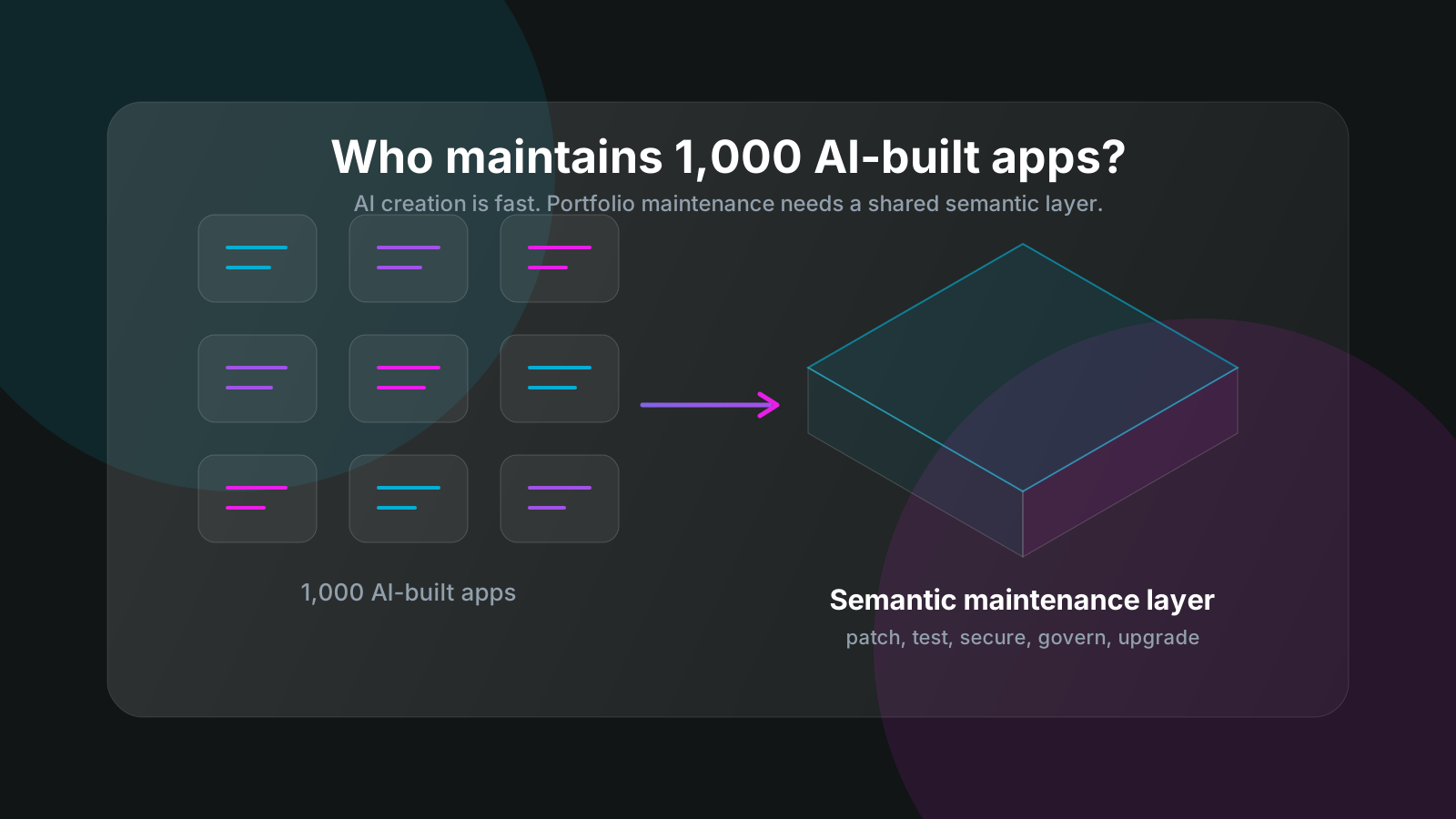
OpenAI Codex Sites changes the software creation conversation in a useful way. It is not just another signal that AI can help write code. It is a signal that AI-assisted creation, hosting, inspection, versioning, and deployment are moving closer together.
OpenAI describes Sites as a Codex plugin that can create, save, deploy, and inspect hosted websites, web apps, and games. The docs also make a practical point that matters for real teams: every Sites deployment URL is a production deployment, and users should review source changes, build status, migrations, access settings, secrets, and deployment URLs before sharing.
Short answer: AI app maintenance is the ongoing work of keeping AI-built software secure, patched, tested, compliant, upgraded, and usable after the first version is deployed. At scale, that becomes harder when every app is a separate generated codebase and easier when common app behavior runs through a governed semantic platform.
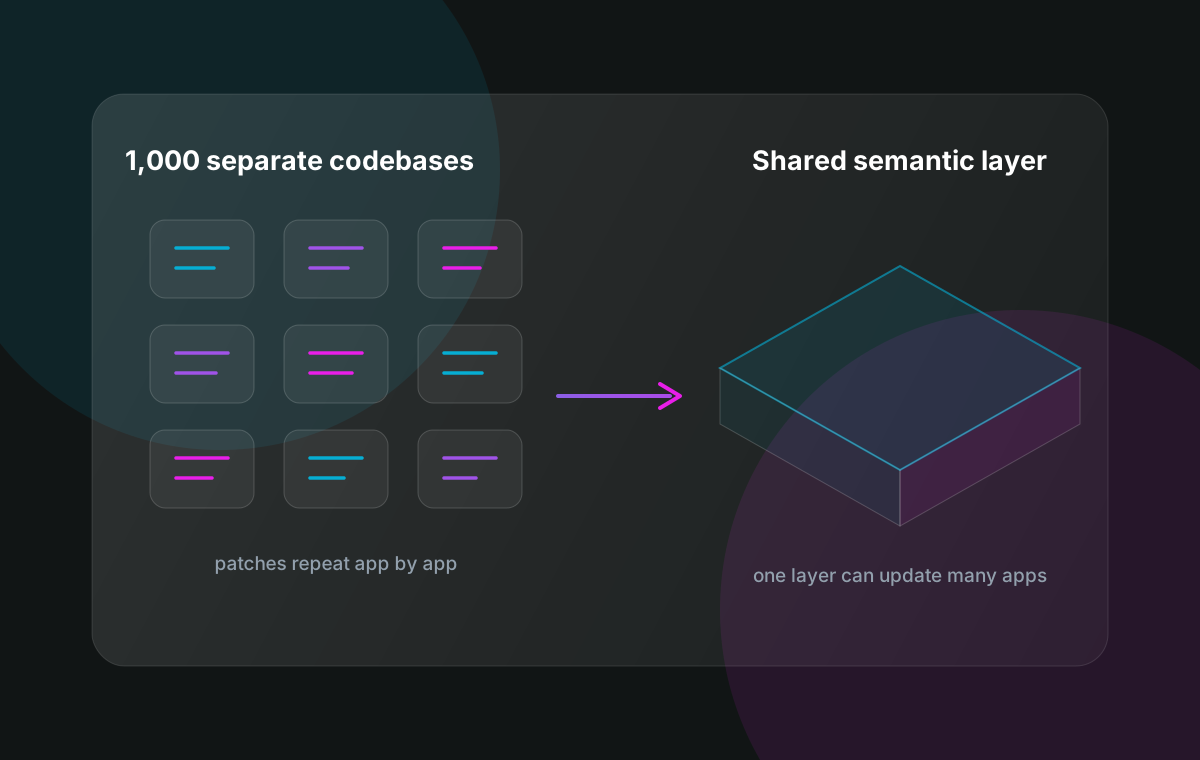
That is the bigger question for businesses. If AI can create one deployed app quickly, what happens when it creates 100? What happens when a company has 1,000 apps? Who patches them? Who tests them? Who verifies access control still works? Who updates the database connector, the authentication logic, the framework version, the privacy rules, and the compliance evidence?
Creation speed is becoming table stakes. Maintenance is where the architecture starts to matter.
Codex Sites changes the question
Codex Sites is important because it makes prompt-to-deployed-software feel more normal. OpenAI's own examples and documentation point beyond static websites into web apps, dashboards, internal tools, persistent data, file storage, workspace identity, access modes, runtime secrets, deployment versions, and compatible existing projects.
That is powerful. It will help developers and technical teams move faster. A technical founder, product engineer, internal tools team, or operations person can ask Codex to build or modify an app, review the source, and deploy it without assembling a separate hosting workflow.
But the release also makes the next problem more visible. Once an app is deployed, the hard work does not end. Software has to be operated. It has dependencies. It has security exposure. It has users. It has data. It has business rules. It has permissions. It has changing regulatory and platform expectations.
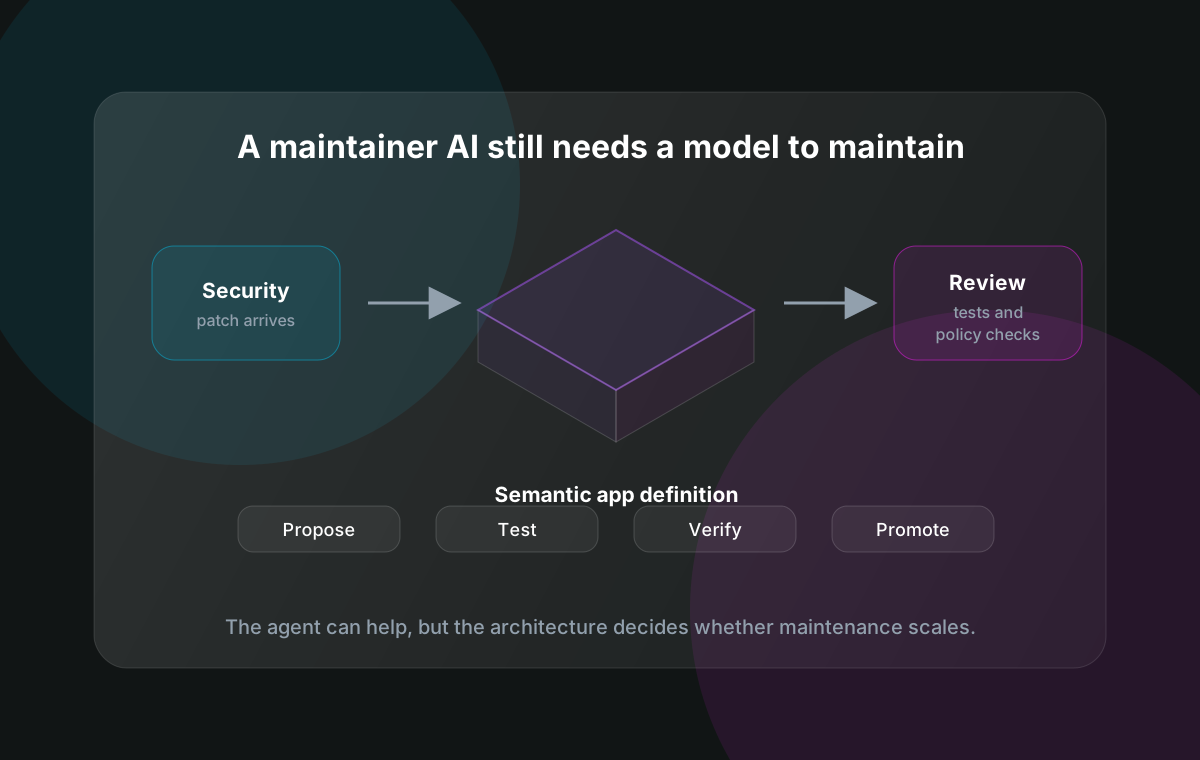
AI can help with those jobs too, but it does not magically erase them. A maintainer agent can propose changes, run tests, and summarize risks. It still needs something coherent to maintain.
The maintenance problem AI does not remove
When people talk about AI building apps, they often focus on the first impressive moment: a prompt becomes a working app. That is useful, but it is not the full lifecycle. After deployment, every production app needs maintenance work such as:
security patches and vulnerability remediation
bug fixes and regression testing
dependency and framework updates
database migrations and connector upgrades
authentication and authorization review
privacy, compliance, and audit changes
secret rotation and environment configuration
monitoring, rollback, and incident response
NIST's Secure Software Development Framework is a useful reminder that secure software is not only about writing code once. It is about reducing vulnerabilities across the lifecycle. OWASP's web application guidance makes the same point from another angle: broken access control, security misconfiguration, insecure design, authentication failures, vulnerable components, and logging gaps are recurring risks.
The question is not whether AI can help. It can. The question is whether AI is maintaining one coherent system or thousands of unrelated implementations.
Scenario 1: 1,000 SMBs each run a maintainer agent
Imagine 1,000 small businesses, founders, or sole operators have each used AI to create a custom web app. Each app has its own codebase. Each app has different generated structure, different dependencies, different naming, different tests, different data model choices, and different hidden assumptions.
Now a serious security patch arrives. Each owner runs a maintainer AI agent. The agent reads the app, proposes changes, updates dependencies, runs tests, and asks the owner to review the result.
That sounds plausible, and in some cases it will work. But it also means there are 1,000 separate maintenance events. The same class of problem may be solved 1,000 slightly different ways. Some owners will review carefully. Some will not. Some apps will have good tests. Some will not. Some patches will succeed. Some will quietly break workflows that nobody thought to test.
This is not a criticism of AI. It is a normal software engineering problem. When every implementation is unique, every maintenance event has to rediscover the local architecture.
Scenario 2: An enterprise creates app sprawl at AI speed
Now imagine an enterprise that gives employees the ability to create applications with AI. The intent is reasonable. Teams need intake forms, dashboards, approval tools, customer portals, lightweight CRMs, asset trackers, training tools, incident workflows, and internal utilities. AI lowers the barrier, so more teams build what they need.
At first, that feels like progress. Then the inventory grows. There may be dozens, then hundreds, then thousands of apps. Some are experiments. Some become business critical. Some hold customer data. Some connect to internal systems. Some were created by employees who have moved teams or left the company.
Now IT, security, legal, and operations need answers:
Which apps exist?
Who owns them?
What data do they store?
Which permissions do they enforce?
Which dependencies are vulnerable?
Which apps need a patch this week?
Which changes need testing before release?
Which apps should be paused, consolidated, or retired?
This is where speed can become sprawl. The faster people create apps, the more important it becomes to have a central way to understand and govern the application portfolio.
Why 1,000 separate codebases become a systems problem
Computer engineers have names for the instincts that show up here: DRY, abstraction, separation of concerns, reuse, shared services, platform layers, typed schemas, configuration over custom code, and common runtime patterns.
Those ideas are not academic. They exist because duplicated implementation creates duplicated risk.
If 1,000 apps each implement their own database access, then a database connector upgrade becomes 1,000 code changes. If 1,000 apps each implement their own authentication logic, then an auth patch becomes 1,000 review paths. If 1,000 apps each encode access control in generated UI and server code, then a privacy rule change becomes a search through 1,000 codebases.
Good engineering usually moves repeated patterns into shared layers. The database connector becomes a platform concern. Authentication becomes a platform concern. Authorization patterns become a platform concern. Logging, release promotion, rollback, test harnesses, and compliance evidence become platform concerns.
That is why semantic layers matter. They are not just a nicer way to describe apps. They are a way to make app behavior legible enough that common platform machinery can operate on it.
Why semantic app definitions scale better
A semantic app definition is a structured model of what an application is: its screens, data, relationships, workflows, roles, permissions, logic, integrations, and lifecycle state. The important point is that the platform can understand the app above the level of arbitrary source files.
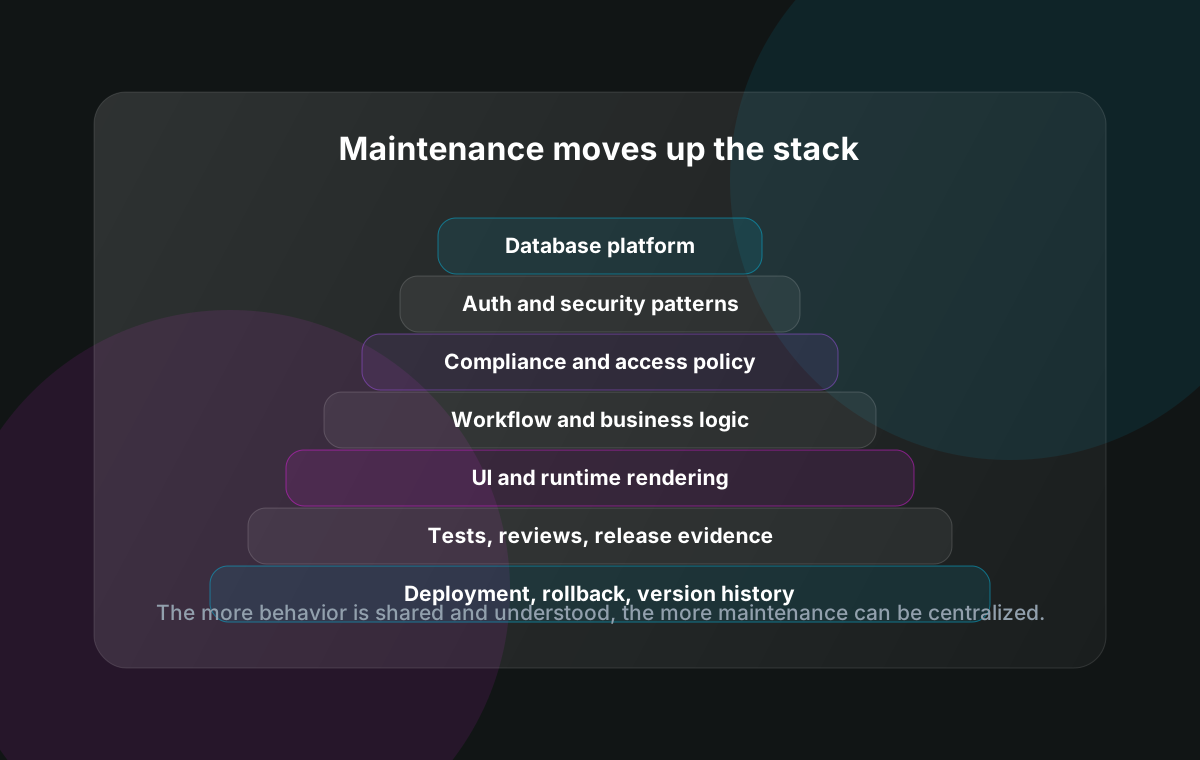
That changes the maintenance problem. If the app runs on a maintained platform engine and the durable app model is expressed as structured definition, more of the maintenance burden can move into the platform layer.
Start at the bottom of the stack. If every app uses a common database platform, the platform can manage connector upgrades, query behavior, backups, environment separation, and data-access conventions more consistently. Move up a layer. If authentication and authorization use shared patterns, then security updates can be applied centrally instead of rediscovered in each app.
Keep moving up. If privacy rules, role logic, workflow states, display behavior, forms, data validation, release promotion, and testable flows are part of the app definition, then the platform has something structured to inspect, update, and verify.
This is the Buzzy argument. The app should not only be generated. It should be defined in a way that can be governed, tested, secured, deployed, and evolved. A generated codebase may be a useful output. A semantic app definition is a more useful control point.
Where the future maintainer AI fits
It is reasonable to imagine that AI maintainer agents will get much better. A future maintainer agent could watch security bulletins, inspect an app portfolio, propose patches, generate migration plans, run automated tests, flag risky access changes, produce release notes, and ask humans for review where needed.
But the agent's success will depend on the system it is maintaining.
If the agent has to work across thousands of unrelated generated codebases, it has to infer architecture again and again. It has to understand local naming choices, local edge cases, local test gaps, local auth logic, local data rules, and local deployment behavior.
If the agent works against semantic app definitions and shared platform services, it can operate at a higher level. It can ask better questions. Which apps use this workflow pattern? Which apps expose this role? Which apps depend on this data connector? Which apps need a staging test? Which apps have a privacy rule affected by this change?
The agent can help either way. The architecture decides whether the work scales.
Security and compliance need more than a patch button
Security patching is a good example because the time pressure is real. CISA's Known Exploited Vulnerabilities catalog exists because known vulnerabilities are actively exploited and organizations need a way to prioritize remediation. The EU Cyber Resilience Act also points in the same direction from a regulatory perspective: software products increasingly need vulnerability handling and security-update processes across their lifecycle.
For AI-built apps, this means the business cannot only ask, "Can AI generate the app?" It also has to ask, "Can we prove the app is maintained responsibly?"
That proof may include logs, tests, dependency status, access-control checks, release approvals, rollback plans, and evidence that private data is protected at the data layer, not merely hidden in the UI. A maintainer AI can help assemble that evidence, but only if the platform exposes the relevant structure.
This is why central control matters. Enterprises need a way to pause access, restrict risky behavior, review data exposure, update common patterns, and verify changes before production. A pile of disconnected generated code makes that harder. A governed semantic platform makes it more realistic.
Where Codex Sites and Buzzy fit
Codex Sites is strongest where a developer or technical team wants an AI coding agent to create, inspect, revise, and deploy a code-based web app. That is a real and useful category. It will be attractive for lightweight web apps, internal tools, dashboards, games, experiments, and compatible existing projects.
Buzzy should not respond by saying, "We also build sites." That misses the more important distinction.
The sharper distinction is this: Codex Sites helps generate and deploy code. Buzzy helps create governed, maintainable applications. Buzzy is strongest when business teams, agencies, product teams, and enterprises want prompt-to-app or Figma-to-app speed without turning every outcome into another codebase they must own indefinitely.
Buzzy's semantic app-definition approach gives the business a clearer place to reason about data, screens, roles, workflows, security, deployment state, and ongoing change. It does not remove the need for responsible configuration, testing, legal review, security expertise, or governance. It does make the application more legible to the platform and to the people responsible for it.
Before you create 100 AI-built apps, ask these questions
The next generation of AI app platforms should be judged by what happens after the first deployment. Before a team creates dozens or hundreds of AI-built apps, it should ask:
Where is the durable application definition?
Who owns dependency and framework updates?
Can security rules be updated centrally?
Can access rules be inspected without reading generated code?
Can common database and runtime behavior be upgraded across apps?
Can regression tests run before patches are promoted?
Can apps be paused, rolled back, or access-restricted quickly?
Can non-developers safely understand and edit the application?
Can the business prove what changed, who approved it, and why it was safe?
Those questions are less exciting than the first prompt. They are also where production software lives.
The takeaway: creation is not the scarce part anymore
AI is reducing the cost of software creation. That is good. More people should be able to turn ideas, workflows, and designs into working applications.
But when creation gets cheap, maintenance becomes the differentiator. Businesses will not only need apps that can be generated. They will need apps that can survive patches, security incidents, compliance changes, framework shifts, database upgrades, and new business requirements.
The future maintainer AI may be very capable. But even the best maintainer needs leverage. The more an application is represented as a semantic definition running on a governed platform, the more the platform and the agent can maintain it as a system rather than as a pile of one-off code.
Next step: If you are exploring AI app delivery for a real workflow, start by mapping the app definition: users, data, roles, screens, flows, security rules, and release path. Then try the new Buzzy Builder MCP. It lets MCP clients such as Codex and Claude Code create and maintain Buzzy apps through semantic app definitions, so teams get the benefits of agentic development without turning every app into another generated codebase to own.
FAQ
What is AI app maintenance?
AI app maintenance is the work required to keep an AI-built application secure, patched, tested, compliant, reliable, and useful after deployment. It includes security updates, dependency changes, bug fixes, data migrations, access review, testing, rollback, and ongoing platform upgrades.
Does a maintainer AI solve generated-code maintenance?
It can help, but it does not remove the architecture problem. A maintainer AI still needs to understand the app, its data, its permissions, its tests, and its deployment path. Maintenance is easier when the app is represented through structured definitions and shared platform services.
How is a semantic app definition different from generated code?
Generated code is an implementation. A semantic app definition is a structured model of the application's screens, data, workflows, roles, permissions, and lifecycle behavior. That model gives the platform a clearer basis for governance, testing, security, and maintenance.
Does this mean Codex Sites is bad for business apps?
No. Codex Sites is useful for developer-led code-based web apps and internal tools. The point is that teams should understand the long-term ownership model. Code generation and hosting are valuable, but production apps still need maintenance, security, testing, and governance.
Related reading
Google, Vercel and Buzzy Point to AI Apps Built from Definitions
Why Semantic App Definitions Are Emerging as the Missing Layer