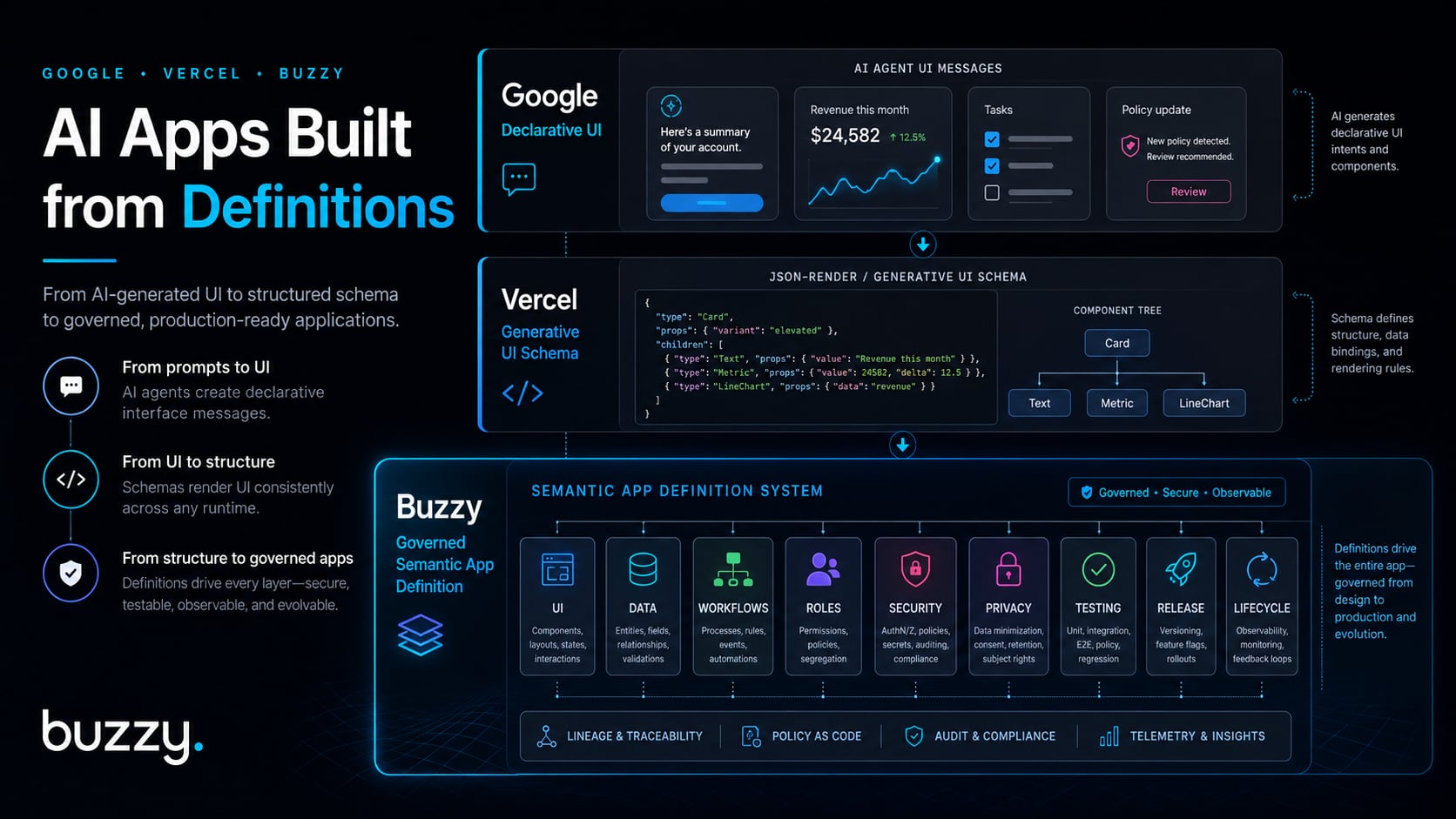
Something important is happening in AI app development. The conversation is moving beyond "Can AI write code?" toward a better question: "Can AI describe the application well enough that trusted systems can build, run, test, and secure it?"
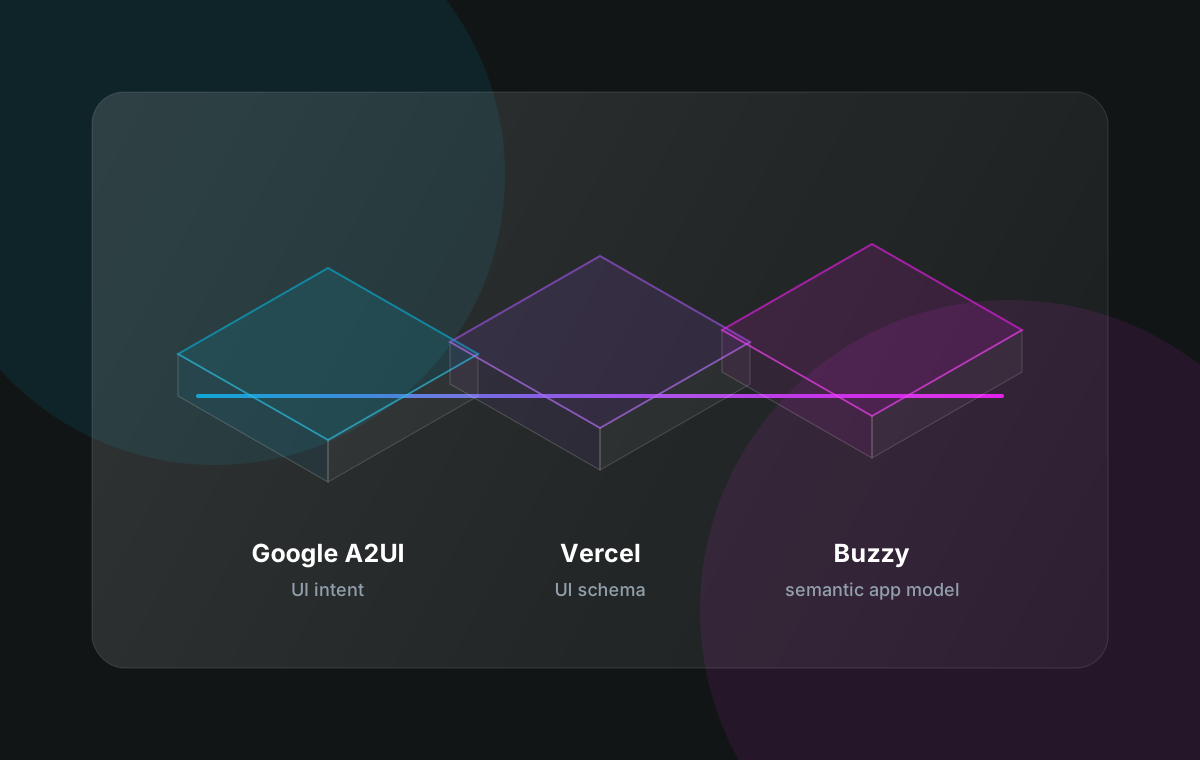
The pattern is becoming visible across the market, but these are not the same product category. Google is pushing hard into agentic AI, app creation, and agent-driven interfaces where agents send declarative UI messages that a trusted client renders. Vercel Labs is exploring the same direction with json-render, a generative UI framework where AI generates JSON interfaces constrained to predefined components and actions. Buzzy is focused on the governed application layer: the semantic app definition that describes the app, its data, its workflows, its security, and its lifecycle.
Short answer: the future of AI-built apps is not just generated code. It is structured application intent: UI, data, workflows, permissions, privacy, release process, and runtime behavior represented in a form that platforms can govern.
That distinction matters because enterprise teams do not only need faster demos. They need applications that can survive real users, real data, real permissions, and real change.
Why Google's latest AI releases make this more urgent
Google I/O 2026 made the direction of travel clearer. Google announced a new wave of models, agents, and tools for building, searching, creating, shopping, and getting work done. The developer story was especially relevant: Google framed the shift as moving from prompts to action, with Gemini 3.5 Flash, Antigravity 2.0, Managed Agents in the Gemini API, and major Google AI Studio updates.
The app-building signals are direct. Google says AI Studio is adding native Android app generation, Workspace integrations, a mobile build-mode app, direct export to Antigravity, in-browser Android emulation, and Google Play internal test-track publishing. Managed Agents add a hosted agent environment where an agent can reason, call tools, execute code, browse the web, and resume state across interactions.
That is powerful, and it also sharpens the lifecycle question. As AI moves from answering questions to building apps, calling tools, using business data, operating in sandboxes, and publishing test builds, teams need more than impressive generation. They need a durable way to define what the app is, what data it uses, what actions are allowed, how it is tested, and how it moves toward production.
Agentic development increases the need for structure. It does not remove it.
Why AI app generation is growing up
Prompt-to-code tools made software feel instant. A founder, product manager, or developer can describe an app and get something working quickly. That is genuinely useful.
But instant code is not the same as a maintainable application. The hard questions arrive after the first demo:
Can the app be secured?
Can permissions be verified?
Can it be tested before production?
Can it be upgraded centrally?
Can the team understand the data, workflows, and security model without reverse-engineering generated code?
Prompt-to-code creates output. Semantic app definitions create leverage. They give teams something higher-level than raw implementation to inspect, govern, and evolve.
Google A2UI: agents need to speak UI safely
Google's A2UI project is a useful category signal because it makes the "definition instead of code" idea easy to understand at the UI layer.
In its A2UI launch post, Google describes a format for agent-generated interfaces that can be rendered in host applications using frameworks such as Lit, Angular, and Flutter. The important security point is that UI layouts are passed as messages, not as executable code. The client owns the rendering and maps the structured UI description to trusted components.
Google's later A2UI v0.9 post sharpens the point: production generative UI needs a clean separation of concerns. A2UI is framed as a framework-agnostic standard for declaring UI intent so agents can use an existing component catalog across devices.
The takeaway is simple: Google is validating the idea that AI-generated experiences need a safe, declarative layer between the model and the runtime. This is especially relevant as more AI assistants embed interactive UIs directly inside AI interfaces, instead of sending users out to a separate app for every task.
A2UI is primarily about the interface layer. AI Studio, Antigravity, and Managed Agents operate elsewhere in the stack: prototyping, code generation, agent execution, tool use, and developer workflow. Taken together, Google's recent releases strengthen the same argument from multiple angles. AI systems are becoming more capable, more interactive, and more action-oriented, so the interfaces, tools, instructions, and application behavior around them need clearer structure.
That is a different job from defining and governing the full application, but it points in the same architectural direction: structured intent beats arbitrary generated output.
Vercel json-render: generative UI gets guardrails
Vercel Labs' json-render project is another strong signal. Its README describes json-render as a generative UI framework: AI generates interfaces from natural language prompts, but the output is constrained to components and actions the developer defines.
That matters because it tackles one of the obvious problems with AI-created interfaces. If a model can emit any arbitrary UI shape, the experience may be flexible but hard to trust. json-render moves the interaction into a safer pattern: a component catalog, a schema, predictable JSON output, and renderers for different targets such as React, Vue, Svelte, Solid, React Native, PDF, email, terminal UIs, 3D scenes, and Next.js.
In other words, Vercel is also validating the move from free-form generation toward structured, renderable intent. It is not the same lifecycle layer as Buzzy. It is closer to the generative UI and rendering layer: how an AI-created interface can be constrained, streamed, rendered, and connected to predefined actions.
That makes it useful evidence for semantic app definitions rather than a replacement for them. If UI benefits from schemas, catalogs, and trusted renderers, the full application benefits even more from a durable definition of data, workflows, roles, privacy, security, release state, and runtime behavior.
Buzzy: the semantic app definition becomes the control point
Buzzy's bigger idea is not "generate an app once." It is define it, run it, secure it, test it, release it, and evolve it.
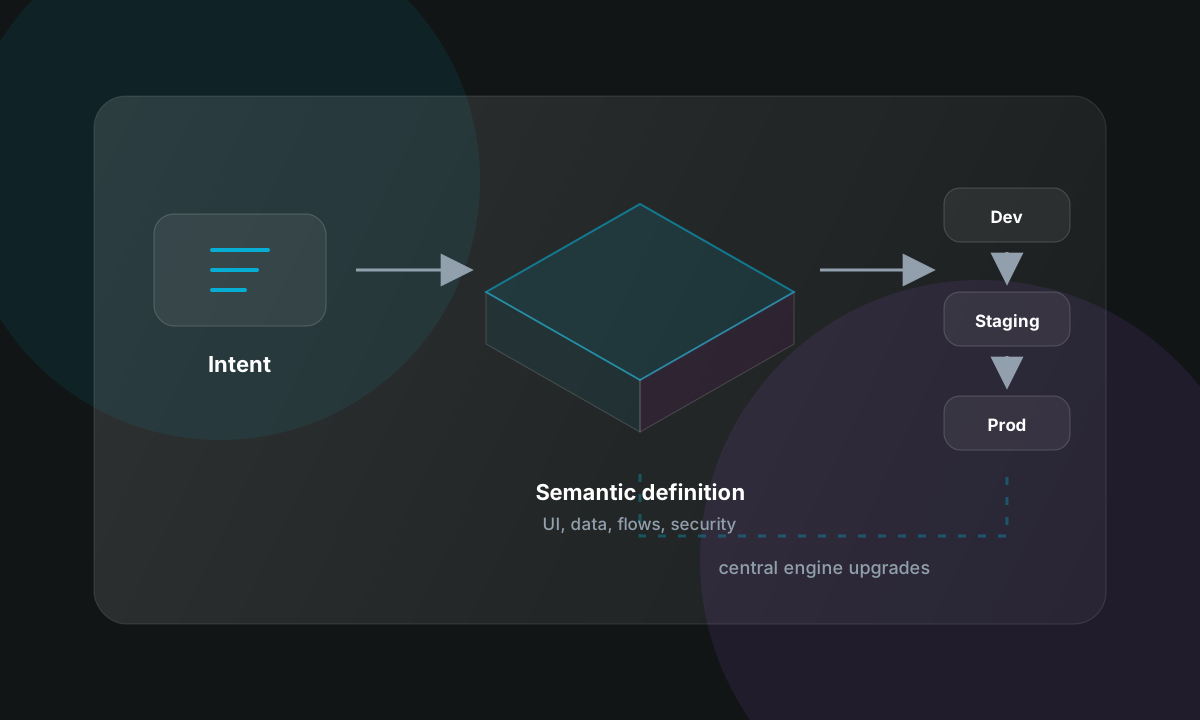
A semantic application definition describes the structure and meaning of the app: screens, components, data model, flows, logic, privacy rules, security settings, actions, and deployment behavior. The app runs on a maintained platform engine instead of becoming a fully separate generated codebase that every team must own indefinitely.
That gives teams a more useful control point. The app definition is not a throwaway artifact. It is the durable source of truth for what the application is supposed to do.
For enterprises, that control point matters as much as the generation itself. A governed application layer gives teams a central place to reason about compliance, security posture, access rules, production release state, and emergency response. If something changes - a policy, a user role, a data rule, or a risk decision - the business needs a clear place to apply that change instead of searching through scattered generated codebases.
This is why the distinction matters for teams using AI. If AI creates only code, the team still has to inspect, secure, test, and maintain every implementation detail. If AI helps create a semantic app definition, the platform has something structured to validate, render, secure, and promote through a lifecycle.
Where MCP widgets fit: consistent AI interfaces
There is another reason semantic definitions matter as AI interfaces become more interactive: consistency.
It is useful for an AI assistant to spin up an interface on the fly. But purely generated UI can also become non-deterministic. The same user may get a slightly different interface on a later request. Different users may get different layouts for the same workflow. That can be interesting in a demo, but it becomes harder to support, document, train, test, and govern in production.
Buzzy's MCP direction addresses that gap. Buzzy's release notes describe MCP support with OAuth 2.1 authentication, auto-generated CRUD tools from the app data model, and embeddable widget screens for rich AI assistant responses. The key product idea is that an AI assistant can use the app through MCP, while the interface shown back to the user can come from a consistent Buzzy widget rather than being improvised from scratch each time.
That gives teams a practical middle path. AI can still participate in the workflow, call tools, and return rich experiences. But the user-facing interface can remain recognizable, testable, and supportable because it is tied back to the app model.
Semantic definitions make apps testable, verifiable, and securable
The important shift is from "AI can build apps" to "AI can help define apps that are buildable, testable, verifiable, securable, and governable."
Flows belong inside the app definition
Buzzy's docs now describe Flows as part of the app definition. Flows add behavioral context alongside the brief, data model, blueprint, and theme. They describe how users move through the app and how key business processes should behave.
That is not a cosmetic detail. Once flows become part of the semantic app definition, Buzzy is no longer only generating screens. It is modelling behavior. Functional requirements become clearer, navigation and conditional paths have more context, and missing data fields can be exposed earlier through states and transitions.
Security is part of the model, not an afterthought
Buzzy's security documentation describes controls from application-level settings down to records and fields. At the app level, teams can choose private, unlisted, or public access. They can assign roles such as Admin, Author, and Audience. They can use authentication options including passwordless login, email and password, and SSO.
At the organization level, Buzzy supports Organizations and Teams for group-based access control. At the data level, datatables can define who can view, submit, or delete records. Viewers and TeamViewers fields can restrict record-level access, and sub-table patterns can inherit access from parent records.
In a traditional generated-code app, security is something developers must inspect, patch, and hope they got right. In Buzzy, security rules can be represented as part of the application model. That does not remove the need for responsible configuration, testing, legal review, or specialist security input for sensitive apps. It does give teams a clearer place to express and verify the access model.
It also points to an enterprise requirement that AI app platforms should not ignore: centralized control. Enterprises need to know whether they can pause access, tighten permissions, remove a risky integration, disable a workflow, or stop an app from being used while an issue is investigated. In practice, that is the governance version of a kill switch. It is much easier to evaluate and operate when app behavior, data access, and release state are visible in a structured model.
Private data is not a hidden UI trick
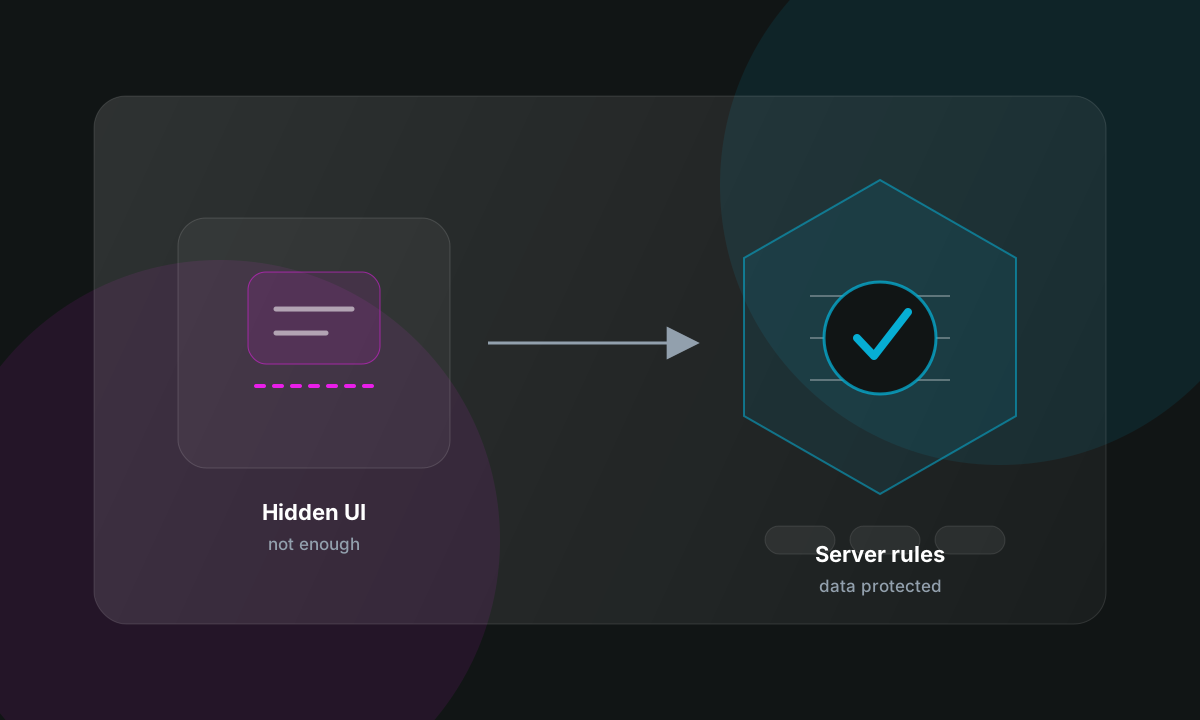
Private data cannot be protected by hiding a field on screen. It has to be protected at the data-access layer.
Buzzy's compliance and security guidance makes that distinction explicit: display rules are for user experience, while server-level security should use mechanisms such as Viewers fields, Teams, and Organizations. The security and access control docs make the same practical point: when data access is configured correctly, the server only fetches data the user is authorized to access.
That is why semantic app definitions matter. The platform can understand who should see what, not just what should be rendered.
Software Config Management adds lifecycle control
Buzzy's Software Config Management gives teams a way to move changes between environments such as Development, Staging, and Production. The docs describe the usual production need clearly: teams want to separate development work from what live users see.
SCM supports safe development, quality assurance, controlled releases, and version history. When a version is pushed between environments, Buzzy packages the app definition - screens, components, fields, actions, display rules - plus assets, and applies them to the target environment. User-related data is typically excluded so each environment can maintain its own users and data.
Because the app is represented as a definition, Buzzy can move it through a professional lifecycle: build in development, verify in staging, release to production.
Google, Vercel, and Buzzy: different tools for different jobs
This is not a winner-takes-all comparison. These tools operate at different layers of the emerging AI app stack.
Tool |
Best understood as |
Where it helps |
Why teams use it |
|---|---|---|---|
Google A2UI, AI Studio, and Antigravity |
Agentic interfaces, app building, and managed agent execution |
Embedding UIs in AI experiences, generating apps, running agents, and connecting developer workflows |
Faster movement from prompt to action, with growing need for trusted UI, tool, and lifecycle boundaries |
Vercel json-render |
A generative UI framework with component and action guardrails |
Rendering AI-generated JSON interfaces through trusted component catalogs |
Predictable UI output across frameworks and surfaces without allowing arbitrary interface code |
Buzzy |
A semantic application platform with a governed runtime |
Business apps with data, workflows, roles, security, SCM, MCP tools, and consistent MCP widgets |
Apps can be built, secured, tested, verified, centrally controlled, exposed to AI assistants, evolved, and maintained |
Google is helping agents express UI, build apps, and operate through managed agent infrastructure. Vercel is showing how generative UI can be constrained by schemas, catalogs, and trusted renderers. Buzzy is building the semantic application layer that lets a real business app be governed for its full lifecycle and exposed to AI assistants through consistent, model-backed interfaces.
Why Buzzy is more than an AI app builder
The strongest Buzzy argument is not only about creation speed. It is about the whole application lifecycle: creation, data modelling, workflow modelling, security, private data, testing, staging, deployment, upgrades, maintenance, governance, and centralized control.
That lifecycle is where generated-code approaches often become expensive. Every generated project may need its own security review, dependency updates, release workflow, platform upgrades, and operating knowledge. At portfolio scale, speed can turn into sprawl.
Buzzy's semantic app-definition model changes the ownership question. The real prize is not generating the first version of an app. The real prize is owning the durable definition that lets the app evolve safely.
For teams comparing approaches, the practical decision is this: do you want another codebase to own, or a structured app model that a governed platform can run?
What enterprise teams should ask before trusting an AI-built app
The next generation of AI app platforms will not be judged by how quickly they generate a demo. They will be judged by whether the resulting application can survive contact with real users, real data, real security requirements, and real change.
Before you trust an AI-built app in production, ask:
Where is the application definition?
Where is the data model?
Where are the access rules?
Where is the central control point for compliance and security?
Can I pause, restrict, or disable risky app behavior quickly?
Can I test the app before release?
Can I verify who sees what?
Can I promote changes safely?
Can I upgrade the platform without rebuilding every app?
That is the difference between AI-generated code and a semantic application platform. Google, Vercel, and Buzzy are useful signals because they show different parts of the same shift: AI needs structured intent, trusted renderers, governed runtimes, and supportable interfaces.
Next step: If you are exploring AI app delivery for a real workflow, start by mapping the app definition: users, data, roles, screens, flows, and release path. Then use Buzzy Create or Buzzy for Figma to turn that intent into a working application you can review, test, and improve.
FAQ
What is a semantic app definition?
A semantic app definition is a structured description of an application's UI, data, workflows, logic, permissions, and behavior. It lets a platform understand and run the app without treating raw generated code as the only source of truth.
How is Buzzy different from prompt-to-code tools?
Prompt-to-code tools mainly generate implementation files. Buzzy is designed around a semantic application model that can include data, workflows, security, and deployment behavior running on a maintained platform engine.
Does this mean generated code is bad?
No. Generated code can be useful, especially for prototypes and developer-led projects. The issue is long-term ownership. If every AI-built app becomes a separate codebase, teams still inherit the security, testing, update, and maintenance burden.